Joseph and Ann Hardey
The Hardeys were working class people. After the English 'Enclosures Act' the family had been granted several fields of land while the records show that Robert Hardey was a Merchant, working his trade from a grain store in the middle of Barrow. (That building still stands in Barrow today.)
Ann Robinson was born on Saturday, the 18th of June in 1800, at Hatfield Chase, in Doncaster. Details of her parents are unknown. (Could have been Richard and Margaret Robinson.)
Joseph Hardey and Ann Robinson were married on Tuesday, the 11th of August 1829, in Hatfield, Hertfordshire, less than a month before departing England. Ann was then 29 years old. |
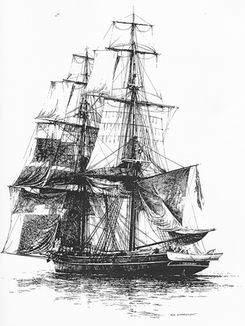 'Tranby' R.H. Shadhow
The young couple sailed from Kingston-upon-Hull upon the chartered brig Tranby. They departed on Wednesday, the 9th of September 1829, as a newly married couple, along with Joseph's two brother's; John Wall Hardey, his young wife Elizabeth; plus, the 16-year-old, William Hardey.
The trip to Western Australia was independently financed. It was backed by a Mr Bernard Clarkson Senior, a banker and member of the powerful Missionary Branch of the Committee of British Methodism. (Bernard Clarkson was a local Methodist preacher at the time John Wesley was still alive.)
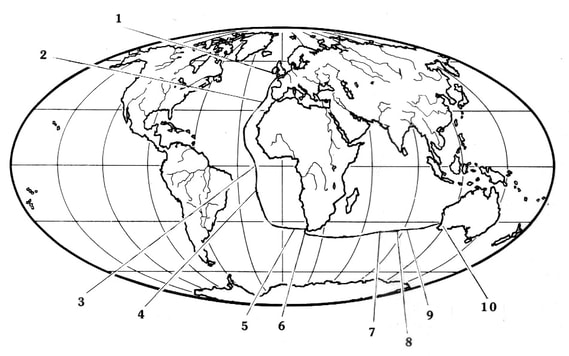
It was to be a 5-month voyage, sailing via Cape Town, in South Africa, and then across the Indian Ocean.
It was to be a 5-month voyage, sailing via Cape Town, in South Africa, and then across the Indian Ocean.
|
1. For pre-departure information about Joseph Hardey and Ann Robinson, in England [Click Here]
|

After Arrival in Fremantle
The passengers on the Tranby sighted the distant ranges (later called the 'Darling Ranges') on Tuesday, the 2nd of February, then the ship rounded Rottnest Island from the north, entered 'Gage's Road' and cast their anchor, in Cockburn Sound on the 3rd of February 1830.

From History of Fremantle site
John Wall Hardey (Joseph Hardey's brother) wrote to England shortly after in July, (extracts appeared the 'Durham Chronicle' Newspaper on the 28th of May 1831) and gives a detailed explanation explained what happened as they entered Gages Road;
"On casting anchor, Mr Scott, the Harbour-master, came to the brig (Tranby) in the Governor’s gig, for documents, &c., and very politely gave Mr M. Clarkson and myself (John Hardy) a passage in the same to the 'Marquis of Anglesea',
On board of which was the Governor. His Excellency gave us a kind and hearty welcome; and after reading our letters of introduction (for which I hope you will thank those gentlemen who so kindly gave us them,) he said he wished more like us would come out, for those who had already arrived, nineteen in every twenty knew nothing about farming. He invited us to call upon him at Perth, which we afterwards did, and had the pleasure of taking wine with him. "
John Wall Hardey continues:
"He [Stirling] then ordered his nephew to get a boat, and take us to examine two parcels of land, either of which we might select. We chose the peninsula, on the account of its superior location, being situated between the two chief towns in the colony, Perth and Guildford. This grant was considered a great favour, as Mr Henty, [James Henty had arrived in November on the Caroline] and I suppose twenty others, had desired to have it, but had been refused. Immediately after getting our goods in shore, which was a work of great labour, we (Messrs. C. and H.) bought the brig’s skiff, and the between deck. We then set to, and with the assistance of the ship’s carpenter, built a flat, 27 feet long, and 8 wide for the purpose of conveying our goods up into the country. "
"On casting anchor, Mr Scott, the Harbour-master, came to the brig (Tranby) in the Governor’s gig, for documents, &c., and very politely gave Mr M. Clarkson and myself (John Hardy) a passage in the same to the 'Marquis of Anglesea',
On board of which was the Governor. His Excellency gave us a kind and hearty welcome; and after reading our letters of introduction (for which I hope you will thank those gentlemen who so kindly gave us them,) he said he wished more like us would come out, for those who had already arrived, nineteen in every twenty knew nothing about farming. He invited us to call upon him at Perth, which we afterwards did, and had the pleasure of taking wine with him. "
John Wall Hardey continues:
"He [Stirling] then ordered his nephew to get a boat, and take us to examine two parcels of land, either of which we might select. We chose the peninsula, on the account of its superior location, being situated between the two chief towns in the colony, Perth and Guildford. This grant was considered a great favour, as Mr Henty, [James Henty had arrived in November on the Caroline] and I suppose twenty others, had desired to have it, but had been refused. Immediately after getting our goods in shore, which was a work of great labour, we (Messrs. C. and H.) bought the brig’s skiff, and the between deck. We then set to, and with the assistance of the ship’s carpenter, built a flat, 27 feet long, and 8 wide for the purpose of conveying our goods up into the country. "
Joseph Hardey later wrote, in a letter to England, (dated July 14th 1832) of the conditions they discovered upon their arrival:
" February, 3rd 1830, arrived at Swan River in the brig Tranby, from Hull, and found many of the emigrants in tents at Fremantle, generally dissatisfied and full of complaints respecting the colony (and some of them ready for going away). The flats up the Swan, the badness of the soil, the heat of the weather, with many others things of the same kind, appeared to be the subjects of general conversation, when worshipping at the shrine of Bacchus; and after being assailed on every hand by such miserable comforters, I found it necessary to leave them and go to look for myself, and after reaching the Peninsula was convinced that the land was of a useful character, and might be made to suit the general purposes of agriculture, although inferior to much of the land higher up the Swan."
" February, 3rd 1830, arrived at Swan River in the brig Tranby, from Hull, and found many of the emigrants in tents at Fremantle, generally dissatisfied and full of complaints respecting the colony (and some of them ready for going away). The flats up the Swan, the badness of the soil, the heat of the weather, with many others things of the same kind, appeared to be the subjects of general conversation, when worshipping at the shrine of Bacchus; and after being assailed on every hand by such miserable comforters, I found it necessary to leave them and go to look for myself, and after reaching the Peninsula was convinced that the land was of a useful character, and might be made to suit the general purposes of agriculture, although inferior to much of the land higher up the Swan."
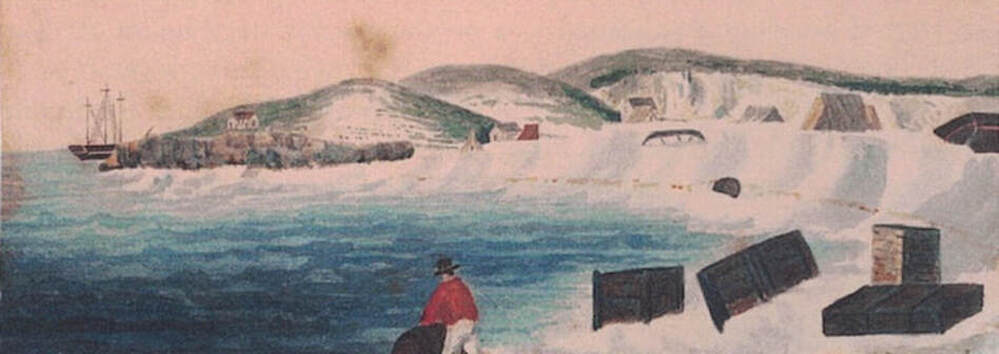
Mary Ann Friend's painting of the south bay c.1830, now the Esplanade Reserve (State Library of Western Australia).
On the 7th February, during his first Sunday in the Colony, Joseph Hardey conducted a service for the Tranby people to express gratitude to God for His care during their voyage. A couple of weeks later, on Monday morning, 22nd February, a service was held to lay the body of young William Hardey to rest at Fremantle. The location of his grave is unknown. Sixteen year old William had died on board the Tranby just 12 days before land was sighted.
The wide range of Livestock, the Goods and Chattels, stores and provisions from England and the Cape were then brought ashore onto the beach via the ship's skiff which had been bought by the Clarkson and the Hardey brothers.
While waiting to occupy land, that would shortly be granted to them, the Hardeys erected, at Fremantle, a temporary building brought out from England. Within three weeks, by the end of February 1830, the first church service was held there.
The wide range of Livestock, the Goods and Chattels, stores and provisions from England and the Cape were then brought ashore onto the beach via the ship's skiff which had been bought by the Clarkson and the Hardey brothers.
While waiting to occupy land, that would shortly be granted to them, the Hardeys erected, at Fremantle, a temporary building brought out from England. Within three weeks, by the end of February 1830, the first church service was held there.
|
From Joseph's Diary:
"February 28, 1830, Mr. Davies, Church Minister, preached in our house this morning, and I spoke in the evening to upwards of 50 people, the first time, I believe, the Fremantle people have been addressed by the Methodists." This Mr. Davies was Church of England clergyman, who was on his way to Tasmania. The ship on which be was travelling remained in port seven weeks, and, during his stay at Fremantle, Mr. Davies held occasional services. |
Of Note: Wesleyan Methodism broke away from the mainstream Anglican protestant church in the 18th century. In Western Australia, Wesleyan Methodism developed an independent denominational character towards the end of the 19th century. |
A lady passenger on the same boat has left on record some interesting impression of the service conducted in Mr. Hardey's house by this visiting clergyman. She says: "The Tranby people formed part of the congregation by joining us, and opened the service of the day by the morning hymn. Several of us were only passing visitors and could not know the deep and powerful feelings of many present whose whole prosperity and hopes of happiness were risked on the success or failure of their exertions in the new colony.
Before we separated, the apparent leader of the Tranby people (Mr. Joseph Hardey) rose and gave notice that divine service would be performed by them according to the rules of their establishment at six o'clock in the evening. They desired all us to attend."
Before we separated, the apparent leader of the Tranby people (Mr. Joseph Hardey) rose and gave notice that divine service would be performed by them according to the rules of their establishment at six o'clock in the evening. They desired all us to attend."
This good lady accepted the invitation and her impressions of the service are well worth reading. "The room was crowded even to standing, but as the entrance had no door, and the windows were without sashes, we had as free a circulation of air as possible. The service consisted of singing and two long prayers, besides the sermon. One woman of the party had a very fine voice, and had not the singing been too loud, it would, on the whole, have been tolerably good. I was much pleased with the sermon, in spite of the Yorkshire dialect in which it was delivered. It was extemporaneous and quite without hesitation. After it was over, we returned home and enjoyed a cool walk."
|
In their early years, Wesleyan Methodism had a separatist flavour. Those joining the community did so out of the conviction that Methodism was a more sincere expression of the Christian lifestyle than Anglicanism. Methodists maintained strong internal bonding through their fellowship meetings and shared experience of petty persecution from the wider community. Their motives were honourable, but the predominantly Anglican colonial society did not take their alternative methods of worship seriously, displaying marked irreverence for the community's convictions in some instances.
|
|
Most early references to Methodism describe the movement as a 'sect'. It is interesting to note, however, that insularity was not a consistent characteristic of the group, as it was common practice for Wesleyans to attend the morning Anglican worship service in addition to their own class meeting and evening service.
The Swan River Colony
The Government by their regulations published in August 1829, had wisely circumscribed the river frontage of every holding, and surveyed the sections to run back some distance from the Swan. These long, narrow blocks came to be called "ribbon grants". In this way, every settler was able to enjoy the advantage of river transport, and the residences were within easy walking distance of each other. The principal early grants were situated above Perth, along the beautiful reaches of the river winding up to Guildford. The river frontage of grants, on either side, fairly evenly faced each other, and the settlers built their houses near the river, on some prominent bank, or on a gentle slope terraced by small hills.
There was a justified criticism that during the first six months of settlement, Stirling had granted much good land to many people who were not bona fide settlers (Civil, Navel and Military officers).
In 1829, Governor James Stirling had reserved two “peninsulas” on the river, one on either side. That on the right was for a racecourse, but his plans for the other are not at present known. Henry Camfield, who came in the Caroline only two months after Perth was founded, with two indentured servants and their families, had been granted the reserve on the left bank (when viewed from the running of the river to the sea). He planned to grow hops for beer, an aim that was favoured by Stirling, who hoped that a supply of beer would lessen the excessive drinking of rum and other spirits that was then prevalent among the “lower classes”. When Camfield took up his grant he named it 'Burrswood' after his father's farm in Kent, England.
There was a justified criticism that during the first six months of settlement, Stirling had granted much good land to many people who were not bona fide settlers (Civil, Navel and Military officers).
In 1829, Governor James Stirling had reserved two “peninsulas” on the river, one on either side. That on the right was for a racecourse, but his plans for the other are not at present known. Henry Camfield, who came in the Caroline only two months after Perth was founded, with two indentured servants and their families, had been granted the reserve on the left bank (when viewed from the running of the river to the sea). He planned to grow hops for beer, an aim that was favoured by Stirling, who hoped that a supply of beer would lessen the excessive drinking of rum and other spirits that was then prevalent among the “lower classes”. When Camfield took up his grant he named it 'Burrswood' after his father's farm in Kent, England.
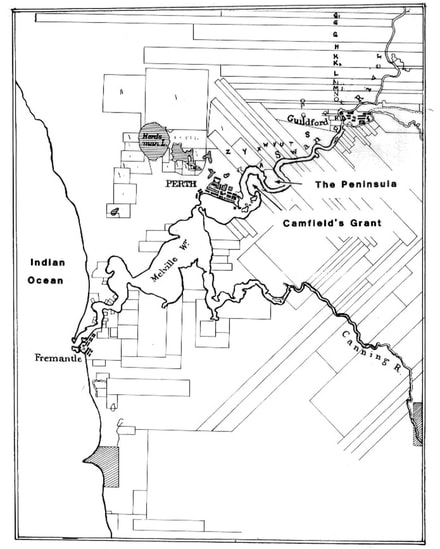
Courtesy SLWA, portion of plan ‘The colony of Western Australia from the surveys of John Septimus Roe Esq. Surveyor General and from other official documents in the Colonial Office and Admiralty’ compiled by John Arrowsmith. 1839. [with annotations]
When the Hardeys and the Clarksons arrived with their chartered ship, bringing with them tradesmen, farmers, servants, livestock, seeds, implements, and their expert knowledge of farming, Governor Stirling decided to sacrifice the projected racecourse so that they could have land close to Perth, and the area was given the name of “The Peninsula” or "Peninsula Farm". (Now part of the suburb of Maylands, in the City of Bayswater.)
In the letter written in July 1832, Joseph Hardey said that although the soil of the Peninsula was inferior to much of the land higher up the Swan, he and his brother (John Wall Hardey) decided that it “might be made to suit the general purposes of agriculture”. To the inexperienced eye, this land, even today in 2019, looks far from promising; Just a short time ago in the 1980's, one part of the property was being used as a sand and clay pit and much of the remainder having yellow clay for subsoil. Two pits (now scenic lakes in the new housing developments) can be seen where clay was removed for brick making.
In the letter written in July 1832, Joseph Hardey said that although the soil of the Peninsula was inferior to much of the land higher up the Swan, he and his brother (John Wall Hardey) decided that it “might be made to suit the general purposes of agriculture”. To the inexperienced eye, this land, even today in 2019, looks far from promising; Just a short time ago in the 1980's, one part of the property was being used as a sand and clay pit and much of the remainder having yellow clay for subsoil. Two pits (now scenic lakes in the new housing developments) can be seen where clay was removed for brick making.
|
The Tranby immigrants, all Methodists and expert farmers, settled together on the 512 acres (207 ha) of the Peninsula, on the Swan River's banks, four miles (6.4 km) east of Perth.
The records of the Surveyor-General, John Septimius Roe show that brothers John Wall and Joseph Hardey were entitled to 16,546 acres of land in the Swan River Colony, the value of their goods and fares for labourers amounting to £1,241. Joseph Hardey was allocated three Lots: 'F '(of 56 acres), 'G '(of 38 acres), & 'H' (of 8 acres) , a total of 102 acres, on the Peninsula, while waiting for further land to be released. |
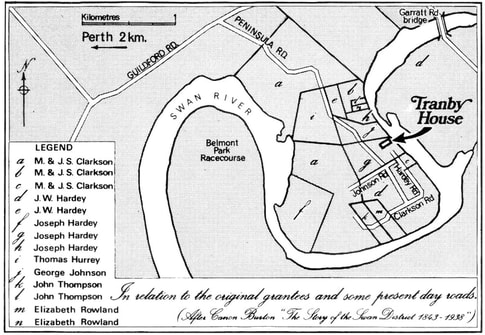
Map reproduced from the 1970s 'Tranby House' information booklet.
|
Early Days at the Peninsula
The basic road between Fremantle to Perth was on the north side of the Swan and was heavy sand and bush. It was therefore virtually non-existent, making any transport of goods and chattels by land very difficult and costly. The Hardeys, Clarksons and others in their party, set about and built a floating wooden "flat", 27ft long, (8.2 metres). This was constructed from the timber between decking from the Tranby with the help of the Tranby's carpenter. On February the 24th, 1830, some of the party, including brother John Wall Hardey, left the struggling settlement of Fremantle to haul it upriver to 'the Peninsula'. Parts of the river were very shallow and rocky. Particularly near what is now known as Harrison Island and the Causeway.
|
The brig “Tranby” with Captain Stoey commanding, departed from Gage Roads bound for Batavia, on the 27th of February 1830, having stayed in port for three weeks.
|
After an inspection of the Peninsula, members of the party and the flat returned, down river to Fremantle, on March the 1st and, that night, it was "set adrift by some unknown". The flat was never recovered, and four days later, the band of settlers set to work to build another one. On Sunday morning, the 7th of March, Mr. Sharp preached in the Hardey house at Fremantle. The following Sunday evening, the missionary, Mr John Leach did the same. On the 17th of March, Mr Sharp (a Church Minister) sailed on board the Gilmore from Fremantle, bound for Sydney.
On the 14th of April 1830, two fellow Tranby passengers; Mr. Thomas Coke Brownell along with his family, and the Missionary Mr John Leach departed Fremantle, bound for Hobart. Joseph Hardey was to keep in touch with them both, by letter, over the following years. Many of the Tranby party were still encamped, in the sand hills, just beyond the beach at Fremantle.
Joseph Hardey along with his farmers and labourers, continued to build his first 'Tranby House' upon his share of the peninsula farm. Barely 3 months after reaching the Colony, Joseph notes, in his diary on April 26-29, 1830: "This week we have been boarding the roof of the House and taring it. Likewise giving the outside two coats of paint".
On Saturday evening, May the 1st, the Hardeys departed the settlement of Fremantle heading upstream, bound for their new home site. The next day being the Sabbath and a day of rest, they "camped under Mount Eliza" (now Kings Park). They arrived at the Peninsula on the 3rd of May. With this floating flat, the settlers transferred all their possessions and livestock from Fremantle, past the struggling settlement of Perth, to the Peninsula, by river. The ‘flat’ measured 9m long (27 feet) by 2.5m wide (8 feet). It was used 13 times by the settlers to transfer goods from Fremantle to the Peninsula.
John Wall Hardey later wrote in 1831: "We erected the wood house at Freemantle, seeing it would take so much getting up into the interior... Brother Joseph and his wife lived in it, till all the goods were conveyed up the river, whilst we, poor fellows, who first went up the peninsula, lived like the patriarch of old, “in tents in the wilderness,” as happy as circumstance would permit."
On the 19th of May 1830, a great storm hit Fremantle driving five vessels onto the shore. On the 21st, the Rockingham was on shore in Cockburn Sound and was breaking up. Rockingham was one of the three vessels that Thomas Peel had chartered to bring settlers to Western Australia. It had arrived on the 14th of May. Upon her arrival, a naval officer guided her through reefs to Cockburn Sound. Peel wished for the settlers and cargo to be brought ashore at once, despite the worsening weather. This meant the Rockingham was nearer shore when a huge storm blew up during the night. The ship’s capstan broke due to the strain put upon it, her rudder was damaged, and the strong winds drove her and four other ships onto the beach. The 180 settlers were landed in the surf, but all survived. The Rockingham was repaired, but after going out to sea for a few days was found to be leaking. She was condemned as unseaworthy and was wrecked again at Clarence.
Immediately upon the Tranby party's arrival at the Peninsula, the completion of houses for all the Tranby families, and the farming of the land commenced. Two weeks after arrival, Joseph Hardey records: "Ploughing behind the house" which indicates building of houses had been undertaken during March and April, before the transfer of the families upriver, in May. Joseph used the wattle and daub method (a popular choice of the day for new settlers).
Brother John Wall Hardey wrote to England, in August, and explained the construction of the first house: "One of the men and I then set to, and built a house, such as it is, being composed of wood, mud, and rushes, about seven yards square. We have two doors and two windows in it, but not one pane of glass in either of them! At one end of our domicile is a store-house, and at the other end lives Joseph Ellis and his wife; whilst, on the back of the house, live our men George Green and Hewson. The Australian edifice stands in the midst of an enclosure or garden, 156 links square, on the banks of the Swan, about 30 yards from the water, set sufficiently above its level, to secure us from floods. Opposite the house, the river expands into a fine sheet of water, about a quarter of a mile broad, on which is occasionally seen the imposing spectacle of 30 or 40 black swans at one time."
Joseph and Ann's first daughter, Ann Margaret Hardey, [1.] was born at 10 o'clock in the evening of 26th May 1830, on the Peninsula Farm. Joseph records: "The Lord has blessed us with a daughter". (Given the arrival date, Ann would have fallen pregnant before the voyage, just after their marriage.)
Brother John Wall Hardey wrote to England, in August, and explained the construction of the first house: "One of the men and I then set to, and built a house, such as it is, being composed of wood, mud, and rushes, about seven yards square. We have two doors and two windows in it, but not one pane of glass in either of them! At one end of our domicile is a store-house, and at the other end lives Joseph Ellis and his wife; whilst, on the back of the house, live our men George Green and Hewson. The Australian edifice stands in the midst of an enclosure or garden, 156 links square, on the banks of the Swan, about 30 yards from the water, set sufficiently above its level, to secure us from floods. Opposite the house, the river expands into a fine sheet of water, about a quarter of a mile broad, on which is occasionally seen the imposing spectacle of 30 or 40 black swans at one time."
Joseph and Ann's first daughter, Ann Margaret Hardey, [1.] was born at 10 o'clock in the evening of 26th May 1830, on the Peninsula Farm. Joseph records: "The Lord has blessed us with a daughter". (Given the arrival date, Ann would have fallen pregnant before the voyage, just after their marriage.)
Joseph Hardey was no doubt the spiritual leader of the group, and although classes were held in the homes on the Peninsula, he chose, like John Wesley, "to be more vide" by preaching in the open air. The oft-quoted note from his diary reads; "Sunday June 6th, 1830, ... went to Perth. Received permission from the Governor to preach. Spoke under a tree." The Methodists continued worshiping under this tree and there were times when even the Governor's wife chose to attend. (The place now marked by a plaque set into the sidewalk) They also received visitors to their home on the Peninsula. On the 9th of July 1830, Hardey records that "The Governor, the Archdeacon, Mr. Peel, Mr. Coles and others have been to see us this day."
Joseph, and his indentured servants, Which included; John Hewson; Joseph and Hanah Ellis; George Green, and Charlotte Stephenson (who arrived at Fremantle as the new wife of Thomas Hurrey), also cleared the land and sowed crops. The first six months on the Peninsula farm, as recorded in Hardey's diary, were spent clearing the land, sowing cereals (including wheat, barley, oats and rye) and vegetables. Hardey reports, "... all came up well, but the fences not being sufficiently good the cattle broke in and destroyed a great part of the crop; that which escaped their ravages came to maturity, and was of a very good description". From his harvest returns he bought three English cows, for £115, from the Governor, James Stirling. The low quality of the natural pastures on the coastal plain was a severe initial problem for the infant colony, and one that was impossible to overcome. Not only was the natural vegetation almost useless as fodder for sheep and cattle but it was also frequently poisonous. To their cost the early settlers were to discover eventually that Western Australia had more toxic plants than any other Australian colony.
A diary entry from the 7th of June records; "Sowing oats. Found Sow in the bush with 10 pigs." On Sunday the 27th of June, Joseph was preaching at the Clarksons.
|
The following winter rains of 1830 were particularly heavy, so much so that the Swan River overflowed its banks on the 19th of July and brought considerable loss and damage to those downstream who were temporarily residing on the Fremantle flats waiting for their grants, and others such as the Hardeys who had elected to build permanent homes on the lower levels adjacent to the river. By the July the 20th, the water was one foot deep in the Hardey house.
That day, the Hardeys were given shelter in the house of Thomas & Charlotte Hurrey, a fellow companion on the Tranby, who owned a property (Lot 'I') on relatively higher safe ground on the Peninsula. The water went slowly down over the next week. Joseph returned to his house on the 29th of July, followed by his wife, and baby daughter on the 30th. The 31st of July was spent drying clothes. |
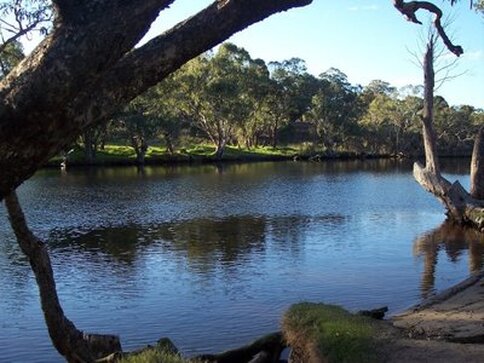
The upper Swan River (via Weekend Notes)
|
Following this heavy rain and the flood in July 1830, some considerable time was spent rebuilding houses that were lost on the Peninsula. This time, Joseph Hardey built a home on higher ground (his second house) and not as close to the Swan River. He was thatching it on the 11th of October 1930. While building this house, the family moved out of the first one on the 14th October and stayed in brother John Wall Hardey's house. By the 15th they were moving goods. The new house was finished by the 19th of October and the family moved in while the labourers continued to thatch and daub the house.
New Land Discovered and Released in the Avon Valley
|
Due to the shortage of good land, attention was focussed on the area inland from the Swan across the ranges. In August 1830, Ensign Dale led a small party that.
successfully penetrated to the east of the ranges and discovered the Avon River. At this time nobody realised that it was in fact the headwaters of the Swan. |
The Hardey brothers, along with the Clarksons, were involved in the exploration of the land to the east over the Darling Ranges. <Click> to read about the discovery, release and settlement of this new land in the Avon Valley, Northam and Yorkshire district.
Joseph's brother John Wall Hardey, Henry Camfield, and the Clarkson brothers accompanied the Governor's party when they departed on the 23rd of October 1830. Joseph should have gone but owing to his wife Ann being unwell and having just moved from his first to the second house, he could not.
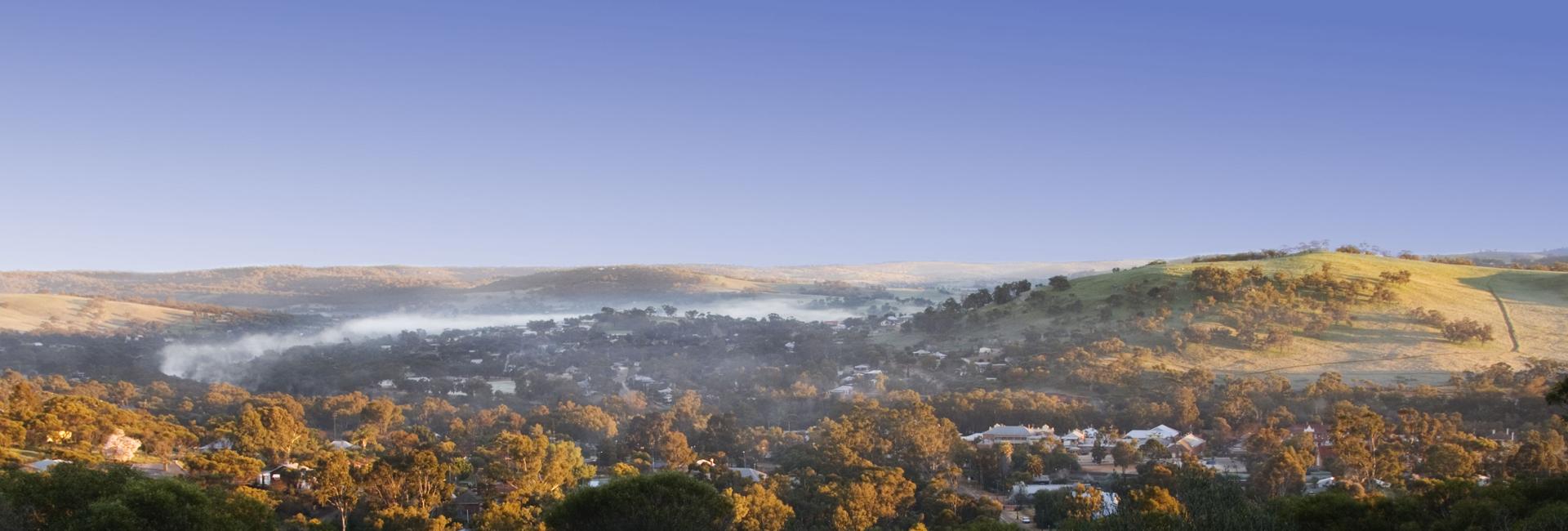
The Avon Valley today (via Destination Perth)
The wooden house erected at Fremantle by the Hardey brothers, upon their arrival, was still standing in July of 1830. Hardey notes in that month that it had been converted into a coffee-house and was returning an annual rent of £78. It is believed it was located on Lot 160 in Short Street, Fremantle and was leased by Richard James and later used it as a public house after he applied for a licence. This was the building that, at the time, was called "Tranby House".
By the end of 1830, the colony had extended its boundaries to include (apart from the military station at King George Sound, which still remained under the Government of New South Wales) settlements at Swan River, Port Leschenault, Guildford, and Augusta, in addition to which areas of land had been assigned in Plantagenet County and in the York-Beverley district. In most of these places little work had been done, but marked progress had been made in Perth and on the holdings along the Swan, Helena, and Canning Rivers, though as yet the returns were insufficient to provide for the sustenance of the community without importing provisions. Fremantle had made but little advance. At the end of the year, it was still practically a camp, and though there were many good citizens who were straining every nerve to develop their properties and improve the condition of things generally, a great part of the inhabitants were of the class that is always afraid of work and particularly loud in expressing disappointment and dissatisfaction. A number of these, most of whom were utterly incompetent as settlers, and some of whom held grants of land, left the colony during the latter half of the year, either abandoning their holdings or arranging for incoming settlers to take them up.
1831
|
In 1831, to enable flat bottomed boats to sail up the river, a canal (called the Old Burrswood Canal) was dug and constructed across Burrswood Peninsula. Thus Camfield's Burrswood Farm became an island. Though barely a quarter of a mile long, this canal shortened the distance between Perth and Guildford from twelve miles to nine miles. This canal was superseded by a canal at Claisebrook in 1839.
A group of islands made up what is now one island known as Heirisson Island. The largest of these had been granted to a settler, J. Furguson, and was 30 acres in area. The islands were linked by a dyke, which diverted water from the Burrswood canal. Early landing places along the river included Whatley Cove (Claughton Reserve). |
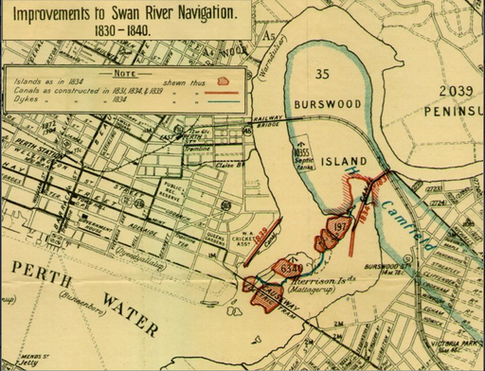
Improvements from 1830 to 1840.
Public domain, via Wikimedia Commons
|
On the 14th January 1831, Joseph Hardey began digging a new well on the Peninsula. The shortage of fresh water was never severe in the Swan area once settlers had learnt to anticipate the summer drought. Where surface water was lacking, or was brackish, wells were usually successful though isolated examples existed where this was not so.
Mixed farming was the initial agricultural response on the Swan, Helena and Canning Rivers and continued in those areas almost to the end of the century. Elsewhere, stock raising, mainly sheep but sometimes cattle, tended to be more important. The crop and animal combination were carefully balanced by farmers and both elements were considered to be of equal importance. Had farmers not kept some stock, they would have been without fertiliser for crops, since animal manures were all that were used for many years. Had they not grown crops they could not have kept some animals such as pigs, for in an economy where money was very scarce and almost lacking, they could not have readily purchased grain.
On Monday, the 5th of September 1831, Joseph Hardey left Guildford with a small party, to travel over the Darling range to the York district. For the next three days it rained. He arrived at Mount Bakewell on the 16th of September. After five days of exploring the area, he set out to return, from Mount Bakewell, on the 21st of September, arriving back at the Peninsula on the 24th of September 1831.
Ann Hardey fell pregnant at the end of December 1831. Their daughter first daughter, Ann Margaret Hardey, [1.1] was about a year and a half old at the time.
Ann Hardey fell pregnant at the end of December 1831. Their daughter first daughter, Ann Margaret Hardey, [1.1] was about a year and a half old at the time.
1832
During February and into March 1832, there were many fires in the Perth district. On the 18th of February, Mr William Brockman's house was burnt down. William Brockman, with his wife and eldest son Edmund, had arrived on the Minstrel in January 1830. He had brought with him a prefabricated house, seven servants, and a number of sheep. Mr Richard Well's (had arrived on the Calista in 1829) house burnt the next month on the 4th of March.
Unexpected though the extremes of summer and winter were, settlers soon adapted to them; and it was a healthy climate, as Stirling put it: "favourable to health in an uncommon degree is the undoubted persuasion of every one with whom I have spoken."
Unexpected though the extremes of summer and winter were, settlers soon adapted to them; and it was a healthy climate, as Stirling put it: "favourable to health in an uncommon degree is the undoubted persuasion of every one with whom I have spoken."
|
On the 2nd of April 1832, Joseph records: "My wife [who would have been 3 months pregnant] providentially preserved from being shot by a gun falling. Praise the Lord for all His mercies'. Joseph and Ann's second daughter, Mary Jane Hardey, [2.] was born in the evening of the 27th of September 1832.
|
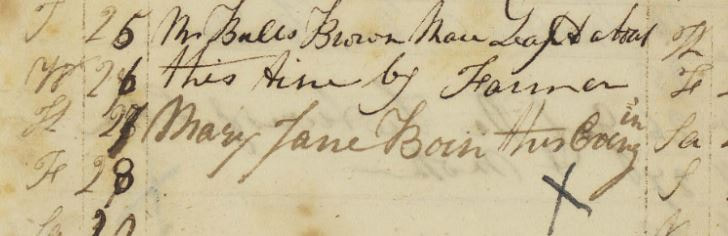
Snip from Joseph Hardey's Diary when Mary Jane was born. (Via State Library of WA)
|
The official census, taken in 1832, records out of around 1,300 residents, 803 were male, 478 were female, and 20 were unknown. That means there were around 35 women for every 65 men, very close to a 1:2 female-male ratio. So, while men were clearly in the majority here, the female population was not negligible. What is more, since there were only around 59 people born in Western Australia by 1832, and assuming half of those were female births, the female population of the Swan River Colony was largely a result of migration and not natural birth. While many came to the Swan River without family, the vast majority, around 858 people, did arrive with at least one family member. A 2016 researcher (Matthew Niendoff) has found, it was also a colony populated younger people. By 1832, 545 people between the ages of 0 and 19 made up about 40% of the colony’s population. The other 60% of the colony’s population was also quite young. The largest age group according to his tally was 20-29, which accounted for around 321 of the settlers, just about a quarter of the population. This means two thirds of the entire population was under the age of 30. Only 23 of the first 1,300 settlers were over the age of 50, and only three residents were over 60.
1833
|
On the 27th of January 1833, Joseph & John Wall Hardey's uncle John Hardey, at the age 54 years, arrived from England via the Cygnet, at Fremantle. He had been born on the 7th of May 1779, in Barrow, Lincolnshire. He was the son of John Hardey (born 1750) and Susannah (Faulding) Hardey (born 1749). John began working on the Peninsula as an 'agriculturist'. [There were now three Hardey's, with the same first initial 'J' associated with the Peninsula]. Prominent Methodists, Barnard Clarkson and George Lazenby arrived on the same ship.
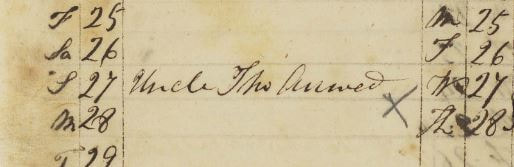
Arrival recorded in Joseph Hardey's Diary. (Via State Library of WA)
The same month, Joseph Hardey walked his cattle from the Peninsula to (Lt) Henry Bull's estate in the Upper Swan for agistment and visited them every few weeks to check on their progress. (Bull's Swan Location 1land was eight kilometres south of what is now known as the suburb of 'Bullsbrook')
|
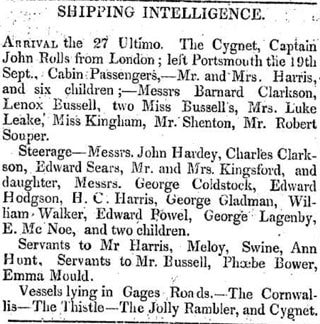
The Perth Gazette - January 1833
|
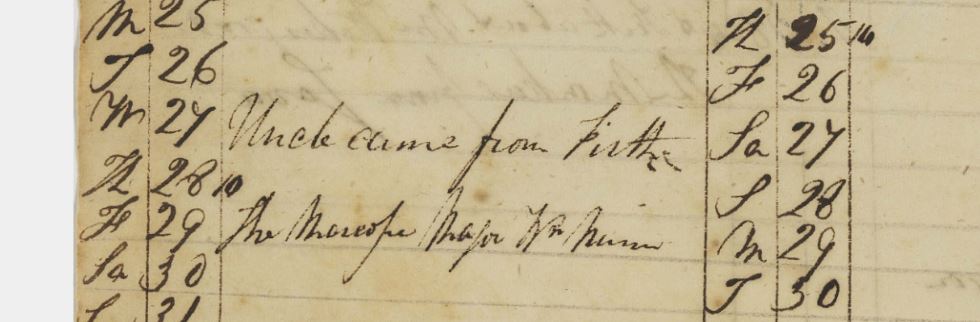
Snip from Joseph Hardey's Diary mentioning Uncle John visiting the Peninsula on the 27th of March 1833.
During 1833, Joseph Hardey is listed as having 15 acres of wheat, growing at the Peninsula. On the 23rd of April, he was granted Town Lot 'W84' (in Wellington Street) in Perth. This Lot was next to one granted to fellow Tranby passenger, George Johnson ('W85'). In August of 1833, both Joseph and John Wall Hardey became Directors on the Western Australian Agricultural Society, under the Patronage of Captain Frederick Chidley Irwin. Irwin arrived in the colony with his 63rd Regiment detachment in the Sulphur in June 1829, six days after the Parmelia, which brought the lieutenant-governor and the first settlers. Irwin was acting as Governor, in the temporary absence in England of Governor (Sir) James Stirling from September 1832 to September 1833.
The Swan River rose again in June 1833 causing a lot of concern. During this year, the first dirt track between Perth and Fremantle was finished. On November the 6th, 1833, Joseph attended fellow Methodist, and Tranby passenger, Mr. Michael Clarkson's marriage ceremony to Jain (Jain) Drummond. (The daughter of the botanist James Drummond). Michael Clarkson was living on the Peninsula, on his property called 'Foggathorpe'. They were married by the Colonial Chaplain, Rev. John Burdett Wittenoom.
The Swan River rose again in June 1833 causing a lot of concern. During this year, the first dirt track between Perth and Fremantle was finished. On November the 6th, 1833, Joseph attended fellow Methodist, and Tranby passenger, Mr. Michael Clarkson's marriage ceremony to Jain (Jain) Drummond. (The daughter of the botanist James Drummond). Michael Clarkson was living on the Peninsula, on his property called 'Foggathorpe'. They were married by the Colonial Chaplain, Rev. John Burdett Wittenoom.
1834
In April 1834, Joseph Hardey became a foundation trustee of Wesley Church, Perth, where he was also a local preacher, class leader and Sunday school superintendent.
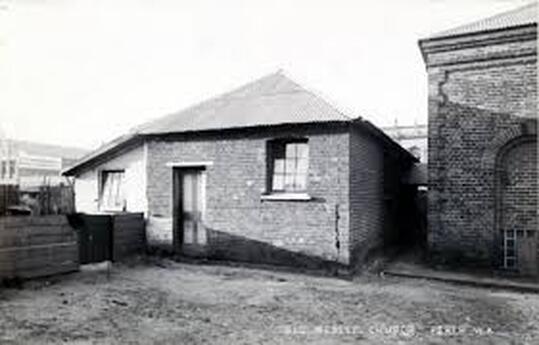 'The First Chapel', Perth. Photograph from the 1860's. The rear of the second chapel to the right.
After four years of open-air worship, it was decided by the Methodists to build a permanent chapel. A block of land, 40 feet long and 80 feet deep, was obtained from James Edwards Inkpen on the corner in Murray Street. This was a portion of the land on which James and his family lived. With no minister to guide them, the colonists met the cost of the chapel by offering £2 shares and consequently, when the small 24-foot x 15-foot building was opened on 22 June 1834, during a very rainy month. Despite its small size it provided a sense of identity and permanence for the Methodists in the young colony.
After four years of open-air worship, it was decided by the Methodists to build a permanent chapel. A block of land, 40 feet long and 80 feet deep, was obtained from James Edwards Inkpen on the corner in Murray Street. This was a portion of the land on which James and his family lived. With no minister to guide them, the colonists met the cost of the chapel by offering £2 shares and consequently, when the small 24-foot x 15-foot building was opened on 22 June 1834, during a very rainy month. Despite its small size it provided a sense of identity and permanence for the Methodists in the young colony.
|
The Perth Gazette of the 28th of June 1834 reported: "The Wesleyan Chapel at Perth was opened on Sunday evening last by Mr Joseph Hardey." The building was built of bricks and roofed with shingles.
[The first chapel built in 1834, was subsequently converted into caretaker's quarters when the second chapel was built, and finally demolished in 1898 when the expansion of the church activities demanded more commodious buildings. (After the current Wesley Church had been completed.)] Having established themselves to this point, these zealous lay Methodists began in earnest to seek for an ordained minister from England. |
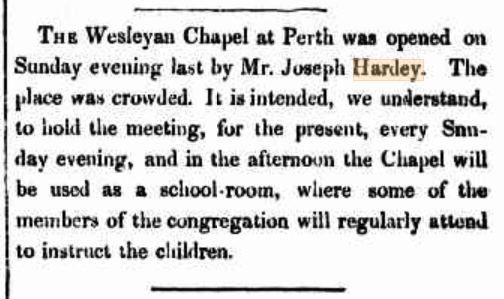
The Perth Gazette and Western Australian Journal (WA : 1833 - 1847) Sat 28 Jun 1834. (Via Trove)
|
The Swan River rose again in July of this year to much concern. Farming continued and crops were planted.
|
Later that same year, Joseph and Ann's daughter, Susannah Hardey, [3.] was born at 4 o'clock in the afternoon of 24th August 1834, on the Peninsula Farm. She was baptised on the 18th of April in 1837, by the Colonial Chaplain, Rev. John Burdett Wittenoom. Wittenoom had arrived 1830 and for 5 years was the only ordained minister in the Colony. (Susannah was to survive into the next century, and died on the 26th of August 1907, in Perth, aged 74 years.)
|
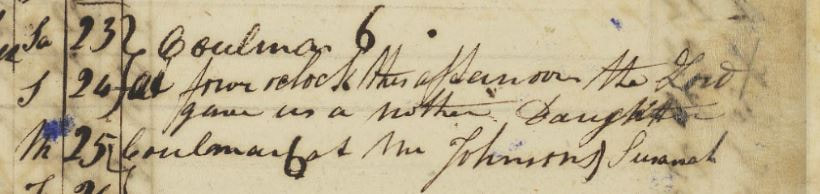
Snippet from the Hardey Diaries with reference to the birth of Susannah Hardey 1834. (Via State Library of WA.
|
November the 4th 1834, Joseph records in his diary: "This has been a very fine season for the Corn Crops. Praise the Lord for all His mercies towards us."
1835
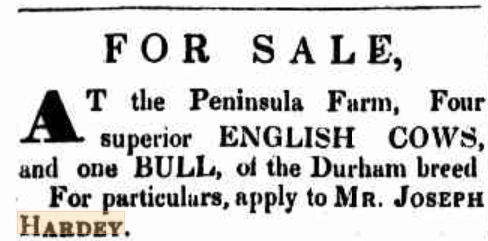
The Perth Gazette and Western Australian Journal (WA : 1833 - 1847) Sat 4 Apr 1835. (Via Trove)
|
The year 1835 began well and productive, and in the autumn, Joseph offered four cows and one bull for sale. In July, Joseph planted a half a cwt. (approx. 25 kilograms) of potatoes in a small plot of land (six yards by twenty long) near his home on the Peninsula. Later, he harvested over 12cwt. (about 610 kilograms) of fine potatoes. |
Also on the Peninsula, during 1835, Joseph built, for less than £200, a substantial windmill which served to grind his wheat.
|
The millwright was James Lockyer, son of the Paul Lockyer, to whom John Gregory gave chief credit for the success of Shenton’s Mill. In the letter to The Perth Gazette [of 6th of May 1837] in which he enters an argument about the South Perth mill, John Gregory, who was a farmer at the 'Pineapple', [now Maylands] a few chains north of the Peninsula Farm on Allotment 'Y', states that Hardey’s mill was “certainly the cheapest mill which has been put up since the commencement of this settlement. Its cost but little exceeds £200, and it would be fully as effectual as the windmill of the disputed design if it were placed in as good a situation .... and observe that Mr. Hardey’s mill has a pair of native 2 feet 10 inches mill stones which the millwright declares are superior to any French burrs he ever put up. Now Mr. Hardey’s mill was put up by a common millwright without any plan or design whatever. It is simple, complete and strong and is provided with a pair of governor balls the action of which is so perfect as nearly to supersede the attendance of the miller.” (Ref: 'Early mills of Perth' Paul Hasluck & F.I. Bray.
|
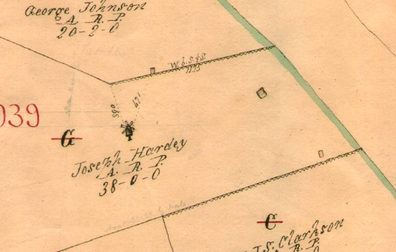
The location of Joseph Hardey's mill as depicted on George Johnsons 1835 Plan.
The existing 'Tranby House' No.3 is to the right near the river.
|
The mill had a large Jarrah stump as its base and the grinding stones, or burrs, are believed to have come from York. No image of further details are available.
On the 2nd of November 1835, Joseph went east over the hills to 'Yorkshire' and returned 'Home' eight days later, on the 10th of November.
On the 2nd of November 1835, Joseph went east over the hills to 'Yorkshire' and returned 'Home' eight days later, on the 10th of November.
1836
On the 29th of April 1836, Joseph records: "I am 32 years old this day. What a mercy. A sinner saved by Grace."
Following its release in 1836, Joseph Hardey selected 16,000 acres (or 6,475 ha) near York, on the Avon River. It was within sight of Mount Hardey. Joseph, and his brother, John Wall Hardey grazed sheep and Cattle on the property over the hills for some time.
By 1836, Joseph had some thirty acres (12 ha) under cultivation, as well as cattle, sheep and horses. On the 1st of June, Joseph set off with "21 beasts to York." He arrived the next day (the 2nd) but was back in Perth, to preach, by Sunday, the 5th of June.
The Swan River flood of 1836 took away the Hardey's second house on the river. After the flood had receded, Joseph, his pregnant wife Ann, and their labourers then set about to rebuild it.
Following its release in 1836, Joseph Hardey selected 16,000 acres (or 6,475 ha) near York, on the Avon River. It was within sight of Mount Hardey. Joseph, and his brother, John Wall Hardey grazed sheep and Cattle on the property over the hills for some time.
By 1836, Joseph had some thirty acres (12 ha) under cultivation, as well as cattle, sheep and horses. On the 1st of June, Joseph set off with "21 beasts to York." He arrived the next day (the 2nd) but was back in Perth, to preach, by Sunday, the 5th of June.
The Swan River flood of 1836 took away the Hardey's second house on the river. After the flood had receded, Joseph, his pregnant wife Ann, and their labourers then set about to rebuild it.
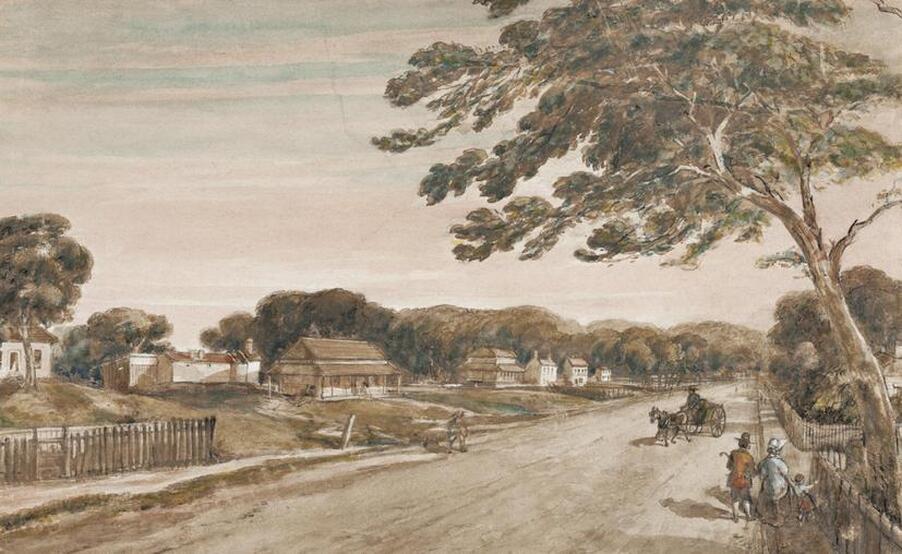
Charles D. Wittenoom A STREET SCENE IN PERTH c.1836 -1837 Identified as St Georges terrace.
Ann gave birth to a fourth daughter: Sarah Elizabeth Hardey. [4.] Sarah was born at 9:45pm in the evening of the 24th of August 1836, at the Peninsula home. Mrs. Lydia Inkpen came to nurse Mrs. Hardey on the 17th, and Lydia remained until the 24th of August. (Lydia was the wife of James Inkpen and had five children of her own.)
|
Sarah Elizabeth Hardey died as a baby, just the next month, at 12:45 in the afternoon of the 11th of September 1836.
Her body was buried in the East Perth Cemetery the next day. (The next year, when another daughter was born to the couple, she was also named: Sarah Hardey.) |
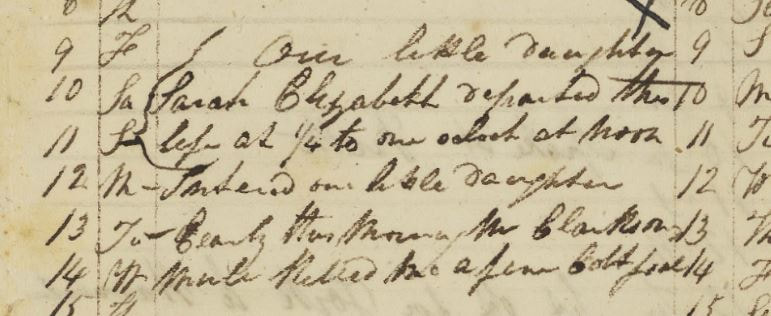
Snippet from the Joseph Hardey Diary recording the death of Sarah Elizabeth Hardey 1836.
|
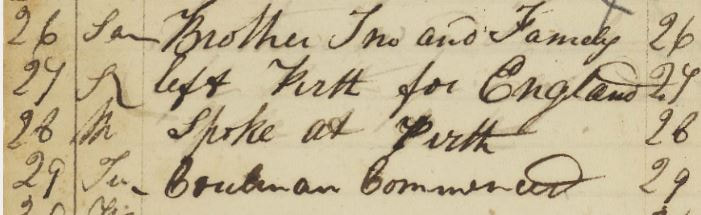
John Wall Hardey leaves Fremantle on the 26th of November 1836.
|
Two months after Sarah's death, on November the 26th, Joseph's brother John Wall Hardey, his wife Elizabeth Hardey, and their family, departed Perth for England, on board the 'Joshua Carrol', sailing via Mauritius.
On the same day, Joseph offered 20 acres of Wheat for sale, ready for harvest, which was growing on the Peninsula. Labour may have been a problem in harvesting it. He offered a barn for the thrashing process. Joseph also advertised 100 acres of land on the Peninsula, plus the fine windmill on it, for sale. |
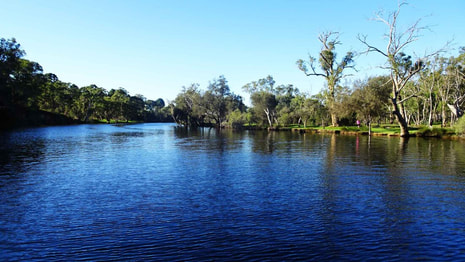
The Swan River near Guildford (via PerthsTinyTours)
|
A ferry operated from a landing at the end of Bridge Street, Guildford, to the opposite bank below 'Cleikum ' Inn. From there, a track ran to Perth on the approximate route of current Guildford Road and another led north to Ellen’s Brook. In 1833, a road was marked out on the east side of the river. People who wanted to travel along the east side of the river waded across the river flats or crossed the river by ferry to a landing at John Hancock’s Mermaid Inn at 'Belmont Farm', then followed the track to the Helena River and Guildford. John and Grace Hancock had been in their 50s when they arrived from England, with their sons George (20) and James (18), on the Warrior in March 1830. They set up home at Belmont Farm where they established a timber-milling business and the Mermaid tavern which was described as a halfway house between Perth and Guildford. But Grace Hancock died in 1833 and John Hancock in 1838.
|
In 1843, completion of the Causeway facilitated road traffic between Guildford and Perth, via Burswood.
1837
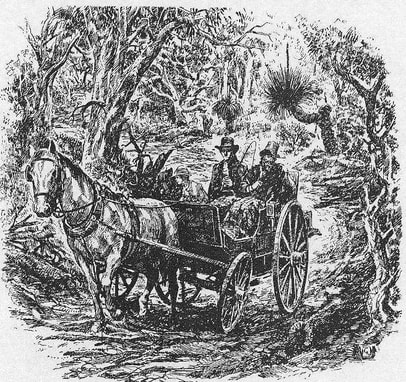 Sketch entitled 'On the Road to York.'
On January the 28th 1837, Joseph arrived at York with his family. He made frequent trips to Perth to preach. During May, native dogs were worrying the sheep. Later, on the 13th of April 1837, Joseph advertised in the Swan River Guardian, for a 'Steady Man as Shepherd' for the Mount Hardey property. Brother John Hardey (Senior) was still on the Peninsula and could be a contact for applicants. Joseph was still advertising next month in May. It was important that the Avon property was a success while brother John Wall Hardey was back in England.
Back at the Peninsula, in 1837, John Hardey (the father of the Hardey brothers, who had arrived in 1833) established a Flour mill, out in a paddock, west of his house known as the 'Mill on The Stump' as it was established at minimum cost (£100) on the stump of a large gum tree with 2 feet round mill stones. James Lockyer (who also assisted building South Perth's Shenton's Mill) assisted in the construction.
Back at the Peninsula, in 1837, John Hardey (the father of the Hardey brothers, who had arrived in 1833) established a Flour mill, out in a paddock, west of his house known as the 'Mill on The Stump' as it was established at minimum cost (£100) on the stump of a large gum tree with 2 feet round mill stones. James Lockyer (who also assisted building South Perth's Shenton's Mill) assisted in the construction.
|
On August the 2nd 1837, at York, Joseph Hardey recorded: "At 1/2 past 9 o'clock this night, the Lord gave us a fifth daughter". She was christened Sarah Hardey. [5.] (Same name as her sister, that had died the year before.)
|
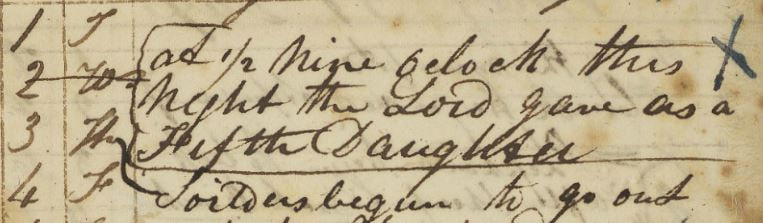
Hardey Diary recording of Sarah Hardey's birth,
|
By October 30th of that year, Joseph recorded that he was setting off for Guildford with a load of wool. Joseph seems to have made York, (Mount Hardey) his headquarters.
|
Uncle John Hardey visited Joseph and his family on the Peninsula from the 1st of December until the 22nd of December 1837.
|

Uncle John Hardey visits. 22 December 1837.
|
1838
|
It seems the news from England of the coronation of "our gracious Queen Victoria, on the 28th of June 1838", was the all-engrossing topic when the news arrived by ship. "The August ceremonial passed off with great magnificence." reported the local papers. Victoria had turned 18 years on the 24th of May 1837. Less than a month later, on the 20th of June 1837, William IV died at the age of 71, and Victoria became Queen of the United Kingdom. |
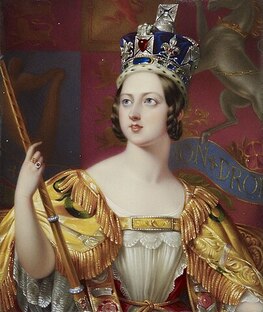
More details
Coronation portrait by George Hayter.
Image via Wiki.
|

The return of John Wall Hardey recorded in the Joseph Hardey Diary 1838 (Via State Library of WA)
|
On the 5th of December 1838, Joseph's brother, John Wall Hardey, wife Elizabeth, and his two children, arrived back in Fremantle from London, England, aboard the Britomart.
|
The ship had left England on the 17th of July 1838. The Britomart had stayed in Cape town between October 2nd and 25th. The ship had been chartered by William Tanner to bring out a further group of Methodists. The passenger list included a good spread of solidly middle-class immigrants: William and Hester Tanner, their children and servant Mary Ann Wells, John Wall and Elizabeth Hardey and their children, Samuel and Elizabeth Viveash, George King, and Robert Viveash.
On the 20th of December, Lady Stirling held a Ball at Government House. A number of the new arrivals attended. It seems that John Wall Hardey returned to Perth with considerable investments. John Wall Hardey then returned to being a Magistrate and managing his property in York.
1839
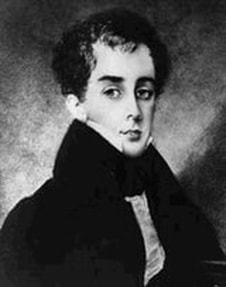
Governor John Hutt Esq.
|
John Hutt, Esq., took office as Governor, in early January 1839, and succeeded Sir James Stirling, who had done so much for the Colony. James had been knighted during his visit to England. Mr. Hutt had previously held the office of Governor of North Arcot, in the Madras Presidency, and had been strongly recommended as Governor of the newly established colony of South Australia.
Elsewhere in the world, the first Opium War between Britain and China flared up during this year. This war was to last until 1842. |
|
In February 1839, just two months after his brother John Wall Hardey's return from England, and arrival back in York, Joseph Hardey and his family moved back to the Peninsula.
In April 1839, Joseph began to build the current Tranby House following the loss of the previous three houses to floods (or burnt down). Fellow Tranby passenger and former indentured employee, George Green commenced the work on the 25th of April 1839. 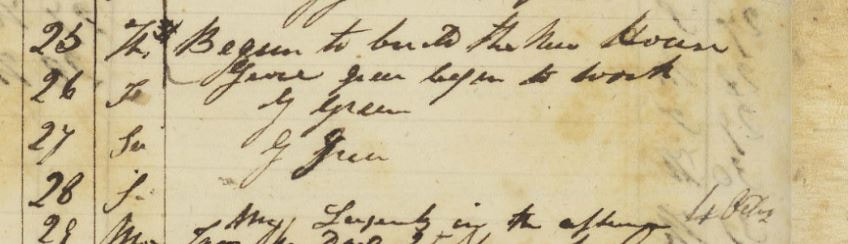
George Green begins work on the third home: 'Tranby House' (Via Hardey Diaries State Library of WA)
|
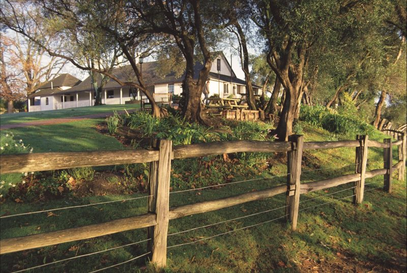
The 1839 Tranby House
|
This house was built from mud bricks, which were made on the property. Joseph (obviously not happy with wattle and daub) constructed a kiln to make his own bricks. In fact, Joseph also made the roof shingles for the house, using Jarrah wood. He records that on the 1st of June 1839: "Mr. Lazenby and J. Lockyer finished putting up the roof of new house."
The house was built in a typical English farmhouse style, described as "colonial domestic" and featured a loft and wide verandas.
The house was built in a typical English farmhouse style, described as "colonial domestic" and featured a loft and wide verandas.
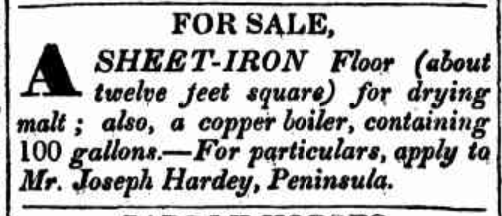
The Perth Gazette and Western Australian Journal (WA : 1833 - 1847) Sat 4 May 1839.
|
It would seem that Joseph had been producing Malt on the Peninsula property. On the 4th of May 1839, he put, up for sale, a sheet iron floor for drying malt as well as a copper boiler containing 100 gallons of malt. |
Regular church services were held at the Peninsula, sometimes with visiting preachers, but the Tranby immigrants wanted more than lay preaching, and requested a minister from the Wesleyan Missionary Society (also known as the English Wesleyan Mission) in London. Rev. William Longbottom was sent out in 1837 on the Fanny, which was on-route via Hobart, but was shipwrecked at Encounter Bay in South Australia. Not long afterward, on the 17th of August 1838, Longbottom discovered a Methodist congregation in Adelaide, which begged him to remain as its minister. He consented and thus never fulfilled his original appointment.
|
Joseph and Ann's last daughter, Elizabeth Hardey, [6.] was born on the 9th of August 1839, on the Peninsula Farm. She was to remain Single. Elizabeth died in the next century, on the 16th of August 1911, at 'Tranby Park', Maylands, aged 72 years. She was buried in East Perth.
|

The birth of young Elizabeth recorded in Joseph Hardey's Diary.
|
The 1840's
In June 1840, the Rev. John Smithies, an earnest and enthusiastic Wesleyan, arrived in the colony with his wife and four children. During the same year, the foundation-stone of a Wesleyan Chapel, to accommodate 300 persons, was laid in Fremantle by His Excellency the Governor. Joseph Hardey was in attendance as part of the building Committee and Trustees for this Chapel along with his old friend Henry Trigg.
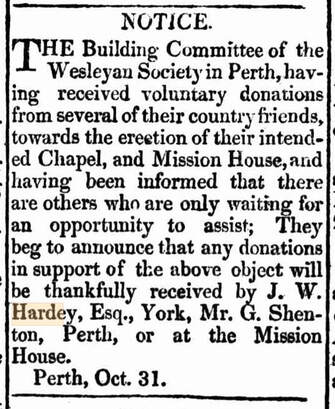
The Perth Gazette and Western Australian Journal (WA : 1833 - 1847) Sat 31 Oct 1840
Page 1
Classified Advertising
|
A Wesley chapel of larger dimensions was projected at Perth. Joseph was involved as part of the building committee and in the raising of the funds. |
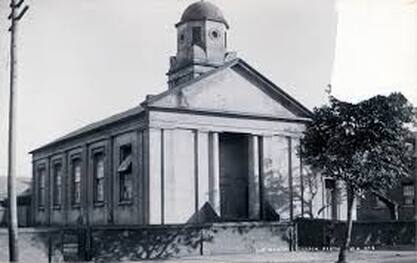 Wesley Subscription Chapel, Perth (original Chapel to the right of picture)
The foundation stone at Perth was laid on the 30th of December 1840, by the Rev. John Smithies. Joseph Hardey made a large donation on behalf of his family to its construction: (Recorded in the press as follows: Hardey, Mr. J. £15,15 shillings; Hardey, Mrs. J. £10,10,0; Hardey, A.M. £5,5,0; Hardy, M.J. £5,5,0; Hardey, S. £5,5,0; Hardey, Sarah, £5,5,0; Hardey, E. £5,5.0 = Total of £52,10,0 or $9,900 AUD value in 2020).
The Perth Chapel opened on the 1st of January 1842, when the Rev. John Smithies again officiated. The Fremantle chapel was opened a short time later, on 24th May 1842.
John Smithies had been born in Sheffield, Yorkshire, during 1802. He was assigned to Western Australia in 1839 and, aboard the Prima Donna, landed on 22 June 1840 with his wife and four children, (two children having died in England, namely, Mary Elizabeth, aged seven months, and Thomas Jackson, aged thirteen months). John Samuel, William Joshua, Alice Hephzibah, and Hannah Mary who was born at sea just two weeks out of Fremantle. Rev. John Smithies established a mission near what is now Wanneroo, in July 1840. The "Perth Native School" was announced with an advertisement in the Inquirer on the 18th of August 1841, including the Board of Management and the Rules and Regulations.
The Perth Chapel opened on the 1st of January 1842, when the Rev. John Smithies again officiated. The Fremantle chapel was opened a short time later, on 24th May 1842.
John Smithies had been born in Sheffield, Yorkshire, during 1802. He was assigned to Western Australia in 1839 and, aboard the Prima Donna, landed on 22 June 1840 with his wife and four children, (two children having died in England, namely, Mary Elizabeth, aged seven months, and Thomas Jackson, aged thirteen months). John Samuel, William Joshua, Alice Hephzibah, and Hannah Mary who was born at sea just two weeks out of Fremantle. Rev. John Smithies established a mission near what is now Wanneroo, in July 1840. The "Perth Native School" was announced with an advertisement in the Inquirer on the 18th of August 1841, including the Board of Management and the Rules and Regulations.
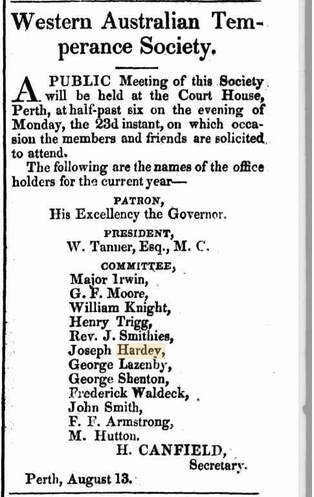
The Perth Gazette and Western Australian Journal (WA : 1833 - 1847) Sat 14 Aug 1841 PrevissueNext issue
Browse issues
Page 1
Classified Advertising
|
By November 1841, Joseph was conducting well attended Temperance Meetings in the Perth Court House. |
By the early 1840's a whaleboat service was conducted twice weekly from Perth to Guildford, past the Peninsula, taking nine hours to complete the trip. The charge of six shillings per passenger was exorbitant when compared with the cost of a passage from London to Fremantle at £18. Some Guildford merchants found it profitable to own a barge of their own, and river transport was to predominate for many decades to come.
Joseph and Ann's first and only son, Richard Watson Hardey [7.] was born on 9th of February 1844. (Birth Reg. 349/1844) Mother Ann was 36 years old at the time of his birth. The population of the colony at the time of his birth, in September 1844, was estimated to be 4,301.
On the 1st of October 1844, at the 'Vineyard Society' Meeting in Perth, under the Chairmanship of His Excellency the Governor, there was exhibited "some excellent samples of red and white wine, the production of Mr. Joseph Hardey, and of white wine, the production of Mr. John Hardey.
On the 4th of January 1847, the Hardey brother's mother, Ann (nee Wall) Hardey, died in Barrow-upon-Humber, in Lincolnshire leaving their father, Robert Hardey a widower. It would have taken months before this news was received in the Colony.
Joseph and Ann's first and only son, Richard Watson Hardey [7.] was born on 9th of February 1844. (Birth Reg. 349/1844) Mother Ann was 36 years old at the time of his birth. The population of the colony at the time of his birth, in September 1844, was estimated to be 4,301.
On the 1st of October 1844, at the 'Vineyard Society' Meeting in Perth, under the Chairmanship of His Excellency the Governor, there was exhibited "some excellent samples of red and white wine, the production of Mr. Joseph Hardey, and of white wine, the production of Mr. John Hardey.
On the 4th of January 1847, the Hardey brother's mother, Ann (nee Wall) Hardey, died in Barrow-upon-Humber, in Lincolnshire leaving their father, Robert Hardey a widower. It would have taken months before this news was received in the Colony.
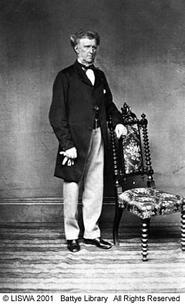
Governor Fitzgerald (via Battye Library)
|
During 1848, Governor Fitzgerald took over from Governor Irwin. He found the Treasury almost depleted and many of the settlers expressing themselves as being thoroughly dissatisfied with the administration that had set too high a price on crown land and had failed to overcome the crippling lack of labour - two factors that discouraged the flow of better-class emigrants.
The census taken in 1848 recorded that there were then in the colony, 3,063 adherents of the Church of England, 276 were Wesleyans, 187 Independents, and 377 were Roman Catholics. It was reported, during November 1849 that; "Two stables and a barn, with some wool were destroyed by fire, at York, the property of Mr. Joseph Hardey; supposed to be the work of an incendiary." |
The 1850's
At the birth of the Colony, optimists predicted and the government planned that 10,000 settlers would arrive at Swan River by 1832.
By 1850, however, Western Australia’s European population was only 5,000, compared to the more recently settled South Australia’s 50,000.
By 1850, however, Western Australia’s European population was only 5,000, compared to the more recently settled South Australia’s 50,000.
|
On the 1st of June 1850, the 21st anniversary of its Foundation, Western Australia lost its status as a 'free colony' with the arrival of the first convict ship, the Scindian. Upon its arrival, Captain Henderson found no suitable goal. Prisoners with 'tickets-of-leave' were sent to various depots (Fremantle, Perth, Guildford, Toodyay, etc.) to work under guard on public works.
Some of these convicts (and later as Ticket-of-leave men) worked on the Peninsula Farm and later at the brickworks. |
Before the arrival of the convicts, the colony had less than 6,000 people. From 1850 to 1868 a total of 9,669 convicts arrived. Their presence in the colony provided the labour to erect public buildings such as the present Government House, the Barracks, the Court House, the Town Hall, the Perth and Fremantle goals etc. By the end of the convict era there were some 23,000 persons, and 1,100 miles of road, 47 major bridges and 79 minor bridges had been constructed.
In 1850, Joseph Hardey acquired Lot I 'Tanner Farm' of 21 acres, from the William Tanner estate. (Tanner had arrived in 1831 and eventually owned a lot of land. The Tanner family left the colony to return to England, on the ship Napoleon” on 14 January 1844. He died, in England, during 1845, but had left an agent to act on his behalf). This lot was the northern location on the Peninsula originally held by Thomas and Charlotte Hurrey.
In 1850, Joseph Hardey acquired Lot I 'Tanner Farm' of 21 acres, from the William Tanner estate. (Tanner had arrived in 1831 and eventually owned a lot of land. The Tanner family left the colony to return to England, on the ship Napoleon” on 14 January 1844. He died, in England, during 1845, but had left an agent to act on his behalf). This lot was the northern location on the Peninsula originally held by Thomas and Charlotte Hurrey.
Another Hardey Arrival
On the 14th of December 1850, there was no doubt a celebration when Joseph and John Wall Hardey's younger brother, Henry Hardey, (who had been born in 1819) his wife Isabella Margurite (nee Elderton) Hardey, and their 5 children arrived at Fremantle, from London, aboard the ship Mary. Young Henry had been aged 10 years old when older brothers, Joseph and John Wall Hardey had left Hull on the Tranby. Henry, and his family, lived on the Peninsula until 1854. By 1857 Henry, his second wife, and his family were living in York. They had one child (Richard Charles Hardey) at that stage, but went on to have eleven children by 1880. [See Here for more Detail]
On the 21st of April 1851, the Hardey brother's father, the widower Robert Hardey died in Barrow-upon-Humber, in Lincolnshire. Again, this news would have taken months to be received in the Colony.
Reverend William Lowe was appointed as a second missionary in Perth during 1852, when Reverend John Smithies was released from his Perth duties and undertook the establishment of Methodism in York. In 1855, Rev. John Smithies left the Swan River for his new appointment in Van Diemen’s Land.
On the 21st of April 1851, the Hardey brother's father, the widower Robert Hardey died in Barrow-upon-Humber, in Lincolnshire. Again, this news would have taken months to be received in the Colony.
Reverend William Lowe was appointed as a second missionary in Perth during 1852, when Reverend John Smithies was released from his Perth duties and undertook the establishment of Methodism in York. In 1855, Rev. John Smithies left the Swan River for his new appointment in Van Diemen’s Land.
|
In July 1852, Joseph was offering turnips for sale at the Peninsula Farm. |
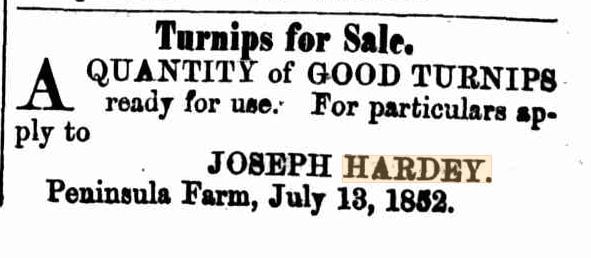
The Perth Gazette and Independent Journal of Politics and News (WA : 1848 - 1864) Fri 13 Aug 1852
Page 5
|
On the 12th of July 1854, Joseph's younger brother Henry Hardey, now a widower aged 35 years, married Isabella Marguerite Elderton. Isabella had been born around 1836, in Ireland, the daughter of Charles Frederick Elderton [Police Constable] & Harriette Robinson Norcliffe Prescott. They were married at Wexcombe, in the Upper Swan Valley area. The couple were living in York, and later moved north to Greenough.
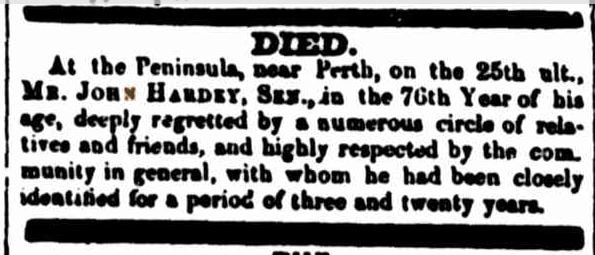
The Perth Gazette and Independent Journal of Politics and News (WA : 1848 - 1864) Fri 5 Oct 1855
Page 2
|
Then the next year, on the 25th of September 1855, Joseph, John Wall & Henry Hardey's uncle, John Hardey died at the Peninsula Farm. He was aged 74 years, 4 months. John had arrived in the Colony on the Cygnet in 1833. (On the same ship as Barnard Clarkson) John had become an Agriculturist on the Peninsula and grew grapes. He had not married.
His body was interred in the East Perth Cemetery, in the family plot, on the 26th of September 1855. |
The Colonial Chaplain, the Reverent John Burdett Wittenoom, died on the 23rd of January 1855. He had singlehandedly conducted Anglican services alternately every Sunday at Perth, Guildford and Fremantle until 1836. John was a family friend and had baptised the Hardey's children.
In 1856, Joseph and Jane would have been sad to see their son Richard depart Fremantle to be educated in England. He was barely 12 years old and was to stay in England until 1866.
In 1856, Joseph and Jane would have been sad to see their son Richard depart Fremantle to be educated in England. He was barely 12 years old and was to stay in England until 1866.
|
On the of 25th of February 1857, Joseph advertised a steam engine for sale from the 'Peninsula Steam Flour Mills'. He may have been selling wine produced by his late older brother, John Hardey. On the 26th of August 1857, the Perth Chamber of Commerce awarded Joseph a special prize of 3 pounds, for a submission of 28lbs of Raisins. |
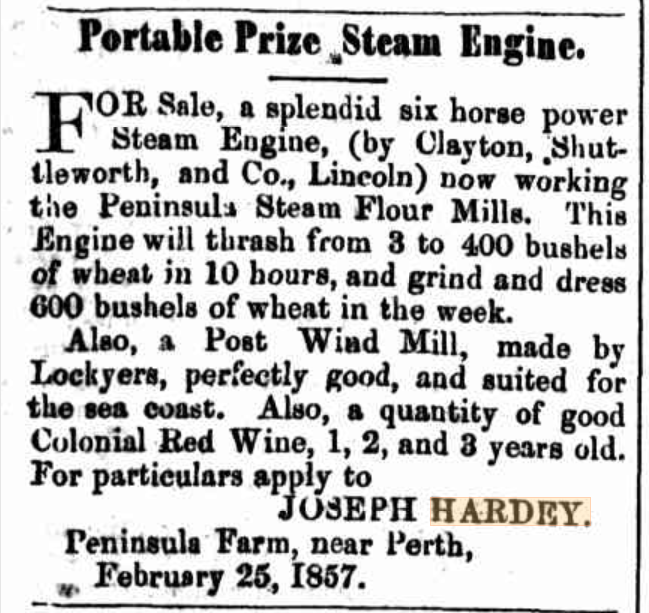
The Perth Gazette and Independent Journal of Politics and News (WA : 1848 - 1864) Fri 20 Mar 1857 (Via Trove)
|
The 1860's
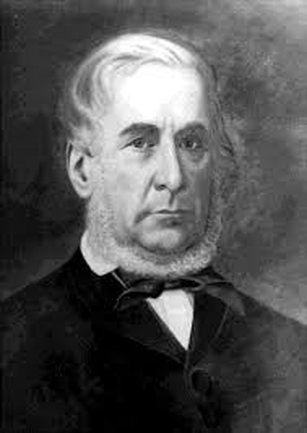 Joseph Hardey (Wesley)
By 1860, Joseph Hardey owned all of the Peninsula Farm, apart from the locations own by Richard Rowland and the Clarkson Brothers. As well as Locations F (Which was later to become 'Maylands Aerodrome' in 1924), G, and H, which were his original grants, Joseph had bought; Locations Aa, I (1850 - Then known as 'Tanner Farm' ), and J (in1835), from the William Tanner estate; Location C (in 1859), from fellow Methodist George Lazenby; and, Locations D (in 1859), E (1859), M (1859) and N (in 1859), from the Mary Hutton estate.
A good area of the Peninsula Farm area was covered in grape vines from the white wine vineyards run by the late John Hardey and Joseph Hardey's red wine vineyards. Another area was the brickworks.
Joseph and Jane's unmarried son, Richard Watson Hardey returned from England during 1866. He was now 22 years old, had completed his education and had worked on a large property. With Joseph now over 60, Richard then took over the management of the Peninsula Farm.
|
His son, Richard Watson Hardey later not only bought the Richard Rowland holdings (in 1875) but also that part of Location A which had remained in the Clarkson family (in 1875 then 1886). This purchase, which fulfilled Joseph Hardey's ambition to own all of the Peninsula, was a fitting conclusion to three decades of remarkable growth and diversification in that locality.
In 1861, Joseph was offering bulk wine for sale at the Peninsula Farm. (By the 'Butt' or 500 litres) |
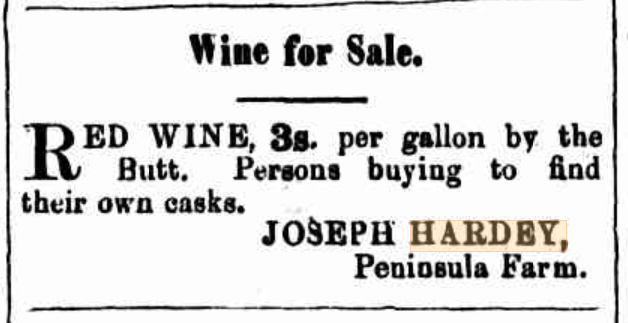
The Perth Gazette and Independent Journal of Politics and News (WA : 1848 - 1864) Fri 19 Jul 1861 (via Trove)
|
|
By the end of the convict era in 1868, the 'vine industry' in the Swan Valley, based on dried fruit and wine production, was well established. By the 1860's the Colony had 400 acres of vines, mostly in the Swan Valley, producing 20,000 gallons of wine and 20,000 pounds of dried fruit. The main winemakers listed as being located on the Swan River were:
|
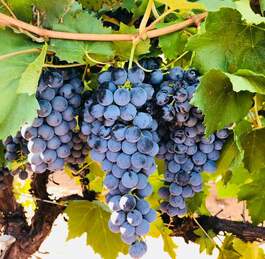
Wester Australian Grapes
|
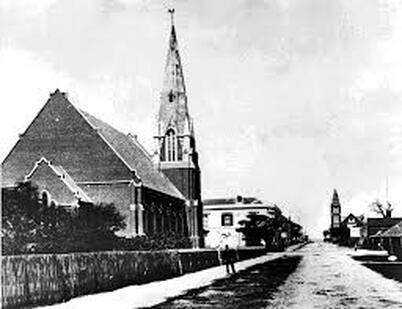 Early photograph of the Wesley Church, Corner of Hay Street, Perth.
The Perth Town Hall in the distance from where the photograph below was taken in 1885.
Early photograph of the Wesley Church, Corner of Hay Street, Perth.
The Perth Town Hall in the distance from where the photograph below was taken in 1885.
By the 1860's the Wesleyans felt that a bigger church needed to be built to replace the second Chapel. Joseph and his wife donated the large amount of £600 (worth around $112,000 in 2019 dollars) to aid in the construction of the new (the third) Wesley Church located on the corner in Hay Street, which opened in 1870.
A brief history of the three Perth Wesley Churches and Chapels can be found [Here]
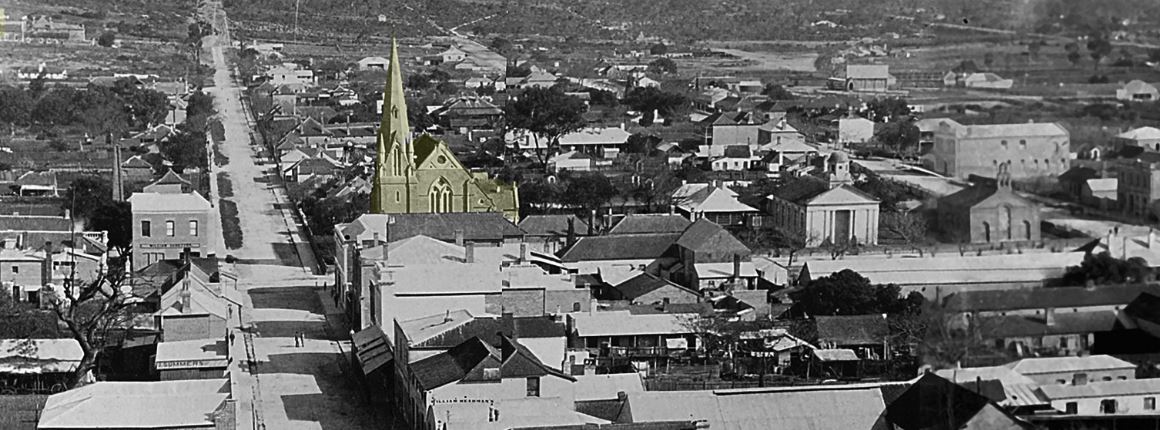
The three Wesley properties along William Street in 1885. Image clip from 'Historical Panoramas' web site. Curtin University.
1870's - The Pioneer Hardeys Die
Joseph Hardey was not attracted by politics and his public offices were few: he was appointed commissioner and guardian to immigrant minors in 1839; a member of the Central Board of Works in 1847; and of the Central Board of Education in 1872-75. Despite Joseph's success, his courage and industry in the adversities of early settlement were appreciated by other colonists, and his sympathetic service in visiting the sick, irrespective of their creed, won him admiration.
Joseph Hardey's younger brother, Henry Hardey, his second wife Isabella, and his family departed Fremantle, on the Eliza Blanch, bound for Melbourne on the 15 November 1870. They had been living at Gwalla (W.A.) from 1866.
Joseph Hardey's younger brother, Henry Hardey, his second wife Isabella, and his family departed Fremantle, on the Eliza Blanch, bound for Melbourne on the 15 November 1870. They had been living at Gwalla (W.A.) from 1866.
|
Joseph's wife, Ann Hardey died on 16th of May 1874, aged 73 years. The cause of death was listed as 'dysentery'. At the time, she was residing at 'Woodbine Cottage' in Perth. (Reg. No. 7049) Her body was buried in the Wesleyan section [Grave 71] of the East Perth Cemetery, on the 17th of May 1874.
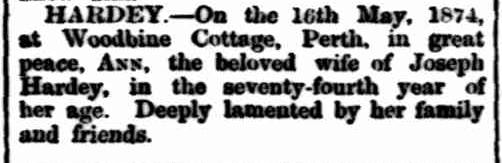
The Inquirer and Commercial News (Perth, WA : 1855 - 1901) View title info Wed 27 May 1874
Page 2
Their eldest daughter, Ann Margaret Wilkin (nee Hardey) died the next year, on the 6th of August 1875, aged only 45 years, from a kidney infection (Reg. No. 8577). She was buried in the Hardey plot, at the East Perth cemetery on the 7th of August. |
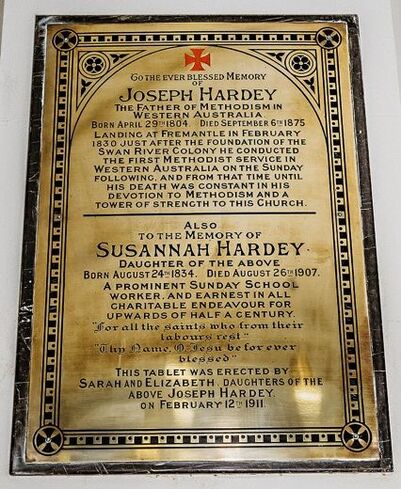
The Hardey Wall Plaque in the Wesley Church, Perth.
Erected by daughters Sarah and Elizabeth.
|
Joseph Hardey died at Perth, on the 6th of September 1875, from an inflammation of the lungs, while living in a house located at 216 Murray Street, Perth (The location of the present 'Forrest Place'). His sixth daughter, Elizabeth Hardey was living there as well until 1911. Joseph left more than £12,000 to the Methodist Church. Quite a large amount [Equivalent to $1,450,000 value, in 2020 dollars]. Joseph's body was interred in the Wesleyan section of the East Perth Cemetery on the 8th of September.
Joseph's last exhortation to his family was to 'stand side to side, shoulder to shoulder, and fight for the Lord'.
Four months after Joseph died, 32-year-old son Richard Watson Hardey married for the time, Jane Vounder Lowe (born in October 1854), Jane was the daughter of Rev. William Lowe, a Wesleyan Minister, and his wife, Mary Rodda. Richard and Jane were married on the 2nd of February 1876, at Guildford. (Marriage Reg. 4049/1876). Jane was 10 years younger than Richard.
Then 6 months after Joseph Hardey's death, Ann and Joseph's second daughter, Mary Jane Hardey, married William Lowe (born during 1819, in England, and now a Widower). They were married at Guildford, on the 8th of March 1876. William Lowe was a Wesleyan Minister. William Lowe died 15 years later, on the 20th of May 1891, in York.
Joseph's last exhortation to his family was to 'stand side to side, shoulder to shoulder, and fight for the Lord'.
Four months after Joseph died, 32-year-old son Richard Watson Hardey married for the time, Jane Vounder Lowe (born in October 1854), Jane was the daughter of Rev. William Lowe, a Wesleyan Minister, and his wife, Mary Rodda. Richard and Jane were married on the 2nd of February 1876, at Guildford. (Marriage Reg. 4049/1876). Jane was 10 years younger than Richard.
Then 6 months after Joseph Hardey's death, Ann and Joseph's second daughter, Mary Jane Hardey, married William Lowe (born during 1819, in England, and now a Widower). They were married at Guildford, on the 8th of March 1876. William Lowe was a Wesleyan Minister. William Lowe died 15 years later, on the 20th of May 1891, in York.
The Hardey Children
Miss Susannah Hardey [3.] died on the 26th of August 1907. She had been at York for a month or two, staying with her elder sister, Mrs. Lowe, and for few weeks at Wesley Manse, where she died at 1 o'clock, Her brother, Mr. Richard W. Hardey, was residing at the old home on the Peninsula.
At the time, Misses Elizabeth [6.] and Sarah Hardey [5.] (Susannah's two unmarried sisters) were residing in Murray Street [near the current Forrest Place] from whence the funeral cortege departed.
Miss Elizabeth Hardey [6.] died on Wednesday, the 16th of August 1911, at the Peninsula (where she was born 72 years before).
At the time, Misses Elizabeth [6.] and Sarah Hardey [5.] (Susannah's two unmarried sisters) were residing in Murray Street [near the current Forrest Place] from whence the funeral cortege departed.
Miss Elizabeth Hardey [6.] died on Wednesday, the 16th of August 1911, at the Peninsula (where she was born 72 years before).
Sarah Hardey [5.], Joseph and Ann's fifth child, was from a very young age was following in the footsteps of her father, undertaking a lot of welfare work in the community for the Methodists and members of other denominations, as well as being deeply involved in the education of Methodist children. She never married. Sarah Hardey , in 1921, gave the substantial amount of £800, to the formative Boys Boarding school, (now Wesley College) for two entrance scholarships in the Hardey family name. By 1932, the two annual scholarship in both Sarah and Joseph Hardey's name, of 21 Guinea's each, was still being presented to students [Each scholarship presented in 1932, would be worth $2,082 each in 2019 dollars]. Sarah Hardey also donated a further £700 in 1920, [Equivalent to $50,000 value in 2019 dollars] to the building fund for a Boys Collage (now Wesley Collage) on vacant land in Coode Street, South Perth.
Sarah Hardey [5.] died on the 16th of June 1921, at her Lawley Crescent residence in Mount Lawley. Later, the property in North Perth, was given to the Methodist mission by the estate of, Miss Sarah Hardey. This home was re-built and known as "Hardey Lodge." It provided accommodation for 12 women, and in addition, to the matron and two assistants as a home for ‘wayward’ girls. This home, and it's successors, have evolved into providing Aged Care to many Western Australians.
Sarah Hardey [5.] died on the 16th of June 1921, at her Lawley Crescent residence in Mount Lawley. Later, the property in North Perth, was given to the Methodist mission by the estate of, Miss Sarah Hardey. This home was re-built and known as "Hardey Lodge." It provided accommodation for 12 women, and in addition, to the matron and two assistants as a home for ‘wayward’ girls. This home, and it's successors, have evolved into providing Aged Care to many Western Australians.
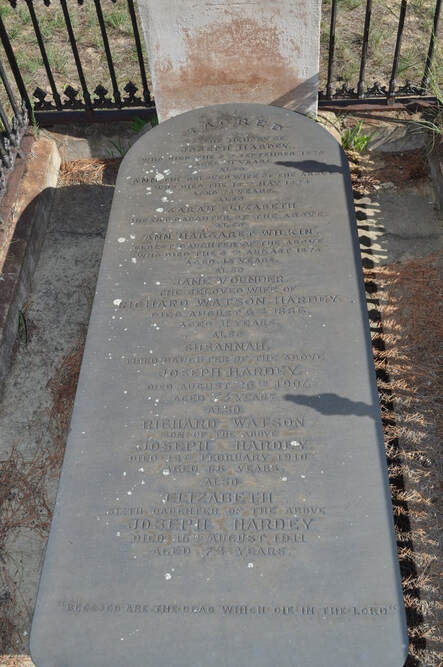
East Perth Cemetery - The family plot.
|
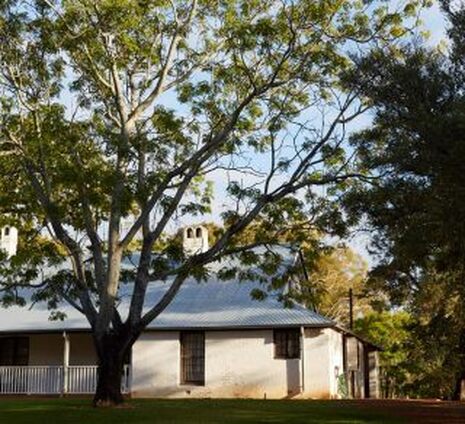
The current Tranby House
|
Peninsula Farm
The 'Peninsula Farm' remained in the Hardey family until 1913.
Joseph and Ann's only son, and their seventh child, Richard Watson Hardey [7.] (Birth Reg. 349/1844) eventually owned a lot of the original properties on the Peninsula. Richard was educated back in England, leaving home in WA at 12 years of age. Richard's first school was in Jersey in the Channel Islands where he attended from 1856 to 1858. He then moved to Leeds at the age of 15 years in February 1859. and then worked on a large estate in Yorkshire, for 5 years. Richard returned to Fremantle, during 1866, at the age of 22 years, to run Peninsula Farm. His father was now over 60 years old.
Richard became a politician and was a member of the Legislative Council of Western Australia on three occasions – from 1876 to 1880, from 1890 to 1894, and then from 1894 to 1896.
The 'Peninsula Farm' remained in the Hardey family until 1913.
Joseph and Ann's only son, and their seventh child, Richard Watson Hardey [7.] (Birth Reg. 349/1844) eventually owned a lot of the original properties on the Peninsula. Richard was educated back in England, leaving home in WA at 12 years of age. Richard's first school was in Jersey in the Channel Islands where he attended from 1856 to 1858. He then moved to Leeds at the age of 15 years in February 1859. and then worked on a large estate in Yorkshire, for 5 years. Richard returned to Fremantle, during 1866, at the age of 22 years, to run Peninsula Farm. His father was now over 60 years old.
Richard became a politician and was a member of the Legislative Council of Western Australia on three occasions – from 1876 to 1880, from 1890 to 1894, and then from 1894 to 1896.
|
Outside of parliament, Richard Hardey had been elected to the Perth Road Board, in 1877, and was appointed Chairman of the Perth City Council in 1890. He served in the position until his death. |
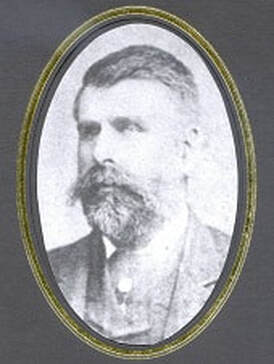
Richard Watson Hardey (via WikiTree) Uploaded on 18 Apr 2021 by Judy (Dyer) Weggelaar
|
Richard Watson Hardey married twice, firstly to Jane Vounder Lowe (born in October 1854), Jane was the daughter of Rev. William Lowe, a Wesleyan Minister, and his wife, Mary Rodda. Richard and Jane were married on the 2nd of February 1876, at Guildford. (Marriage Reg. 4049/1876). Jane was 10 years younger than Richard. This was the same year (on the 8th of March 1876) that Richard's older sister, Mary Jane Hardey married the widower, Rev. William Lowe (Jane's father) at Guildford.
Richard and Jane had one child:
7.1 Hubert Richard Lowe Hardey was born on the 22nd of September 1882, on 'The Peninsula'. (Birth Reg. 23436/1882)
He was four years old when his mother Jane died.
Following his mother's death, young Hubert at four years old, was sent to live at York with the family
of his mother's father, the Rev. William Lowe.
Hubert is listed as living in Port Hedland, at 'Strelley Station' during 1905. This is a pastoral station.
The 32-year-old Hubert married Elsie May Peters (born during 1881, in S.A.).
They were married in Henley Beach, South Australia, on the 4th of February 1914.
They had one child. By 1941, they were listed as living in 'Tranby Park' Serpentine.
7.1.1 Richard James Hardey was born on the 16th of January 1916, in Mount Lawley.
(Birth Reg.Perth:100290/ 1918) After school, he became a Clerk at Elder Smith & Co. Ltd.
In 1941, he was living at 5 Bralt Road, in Claremont.
Richard Watson Hardey married twice, firstly to Jane Vounder Lowe (born in October 1854), Jane was the daughter of Rev. William Lowe, a Wesleyan Minister, and his wife, Mary Rodda. Richard and Jane were married on the 2nd of February 1876, at Guildford. (Marriage Reg. 4049/1876). Jane was 10 years younger than Richard. This was the same year (on the 8th of March 1876) that Richard's older sister, Mary Jane Hardey married the widower, Rev. William Lowe (Jane's father) at Guildford.
Richard and Jane had one child:
7.1 Hubert Richard Lowe Hardey was born on the 22nd of September 1882, on 'The Peninsula'. (Birth Reg. 23436/1882)
He was four years old when his mother Jane died.
Following his mother's death, young Hubert at four years old, was sent to live at York with the family
of his mother's father, the Rev. William Lowe.
Hubert is listed as living in Port Hedland, at 'Strelley Station' during 1905. This is a pastoral station.
The 32-year-old Hubert married Elsie May Peters (born during 1881, in S.A.).
They were married in Henley Beach, South Australia, on the 4th of February 1914.
They had one child. By 1941, they were listed as living in 'Tranby Park' Serpentine.
7.1.1 Richard James Hardey was born on the 16th of January 1916, in Mount Lawley.
(Birth Reg.Perth:100290/ 1918) After school, he became a Clerk at Elder Smith & Co. Ltd.
In 1941, he was living at 5 Bralt Road, in Claremont.
|
Richard enlisted in the RAAF on the 26th of May 1941 (Service No. A9300)
He was commissioned as a Pilot Officer and eventually became a Flight Lieutenant Air Crew II. Trained at Cunderdin and Geraldton. He served with 12 Squadron and No. 34 Squadron in Amberley and Laverton. He participated in an operational tour with 21 SQN from March 1945 to Nov. 1945. Richard flew, Tiger Moth DH82's, Ansons, DH84, Douglas DC3, Lodestar C60A and the Liberator B24 as a captain in 1944/45. Richard was discharged on the 30th of January 1946. |
|
Richard married Joyce Elizabeth McKee, in Claremont, during 1947. (Marriage Reg, Perth: 100849/1947)
Richard James Hardey died on the 6th of June 1976, in Scarbough. (Death Reg. Perth: 102031/1976)
aged 58 years old. His wife Joyce was living at 66 Millcrest Street, Scarborough at the time.
Hubert Richard Lowe Hardey died on the 30th of August 1956, in Nedlands, aged 73 years old.
(Death Reg. Perth: 102303/1956)
Elsie May Hardey (nee Peters) died on the 3rd of October 1962.
Richard James Hardey died on the 6th of June 1976, in Scarbough. (Death Reg. Perth: 102031/1976)
aged 58 years old. His wife Joyce was living at 66 Millcrest Street, Scarborough at the time.
Hubert Richard Lowe Hardey died on the 30th of August 1956, in Nedlands, aged 73 years old.
(Death Reg. Perth: 102303/1956)
Elsie May Hardey (nee Peters) died on the 3rd of October 1962.
By October 1885, Hardey's Peninsula Brick Company was turning out bricks at a rate of a hundred thousand a week.
|
Richard's wife, Jane Vounder Hardey (nee Lowe) died young, four years after giving birth to Hubert, on the 6th of August 1886, aged just 31 years, in York, at her father's home. (Buried at East Perth.) (Death Reg. 14153/1886) A large funeral service was held on Sunday, 15th of August, at the Wesleyan Chapel, York. It was listened to by one of the largest congregations that ever assembled in the Wesleyan Chapel. |
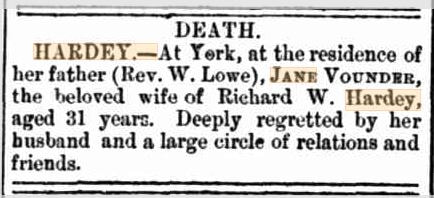
The Daily News (Perth, WA : 1882 - 1955) Thu 12 Aug 1886
Page 3
|
Following his mother's death, young Hubert at four years old, was sent to live at York with the family of the Rev. William Lowe.
There were a good number of ladies and gentlemen present at the laying of the foundation stone for the new Wesleyan School and Chapel in Brisbane Street, Perth. The ceremony was performed by Richard Wall Hardey M.L.C. The Rev. J. Young Simpson conducted the service, and Mrs. T. Halliday presided at the organ.
Richard married six years later, Kathleen Emilie Beurteaux (born during January 1866, in Mildura, Victoria). The 26-year-old Kathleen was the daughter of a local dentist. They were married on the 1st of September 1892, in the new Wesley Church, Perth. (Marriage Reg. 269/1892) Richard's son Hubert was by then 10 years old but had had little contact with his father.
Richard and Katheen then had two children.
Richard married six years later, Kathleen Emilie Beurteaux (born during January 1866, in Mildura, Victoria). The 26-year-old Kathleen was the daughter of a local dentist. They were married on the 1st of September 1892, in the new Wesley Church, Perth. (Marriage Reg. 269/1892) Richard's son Hubert was by then 10 years old but had had little contact with his father.
Richard and Katheen then had two children.
|
7.2 Joseph Hardey was born on the 13th of July 1893, in Perth, to Kathleen.
(Birth Reg. 1367/1893) Joseph enlisted for service in the AIF during WW1, as Service No. 81. He departed for France and attained the rank of Corporal. Joseph had never been married. |
|
Joseph Hardey (jnr) was Killed in Action on the 29th of July 1916, at Pozieres, France, aged 23 years old.
His memorial is at Villers-Bretonneux Memorial, Villers-Bretonneux, Picardie, France.
His memorial is at Villers-Bretonneux Memorial, Villers-Bretonneux, Picardie, France.
7.3 Gretchen Kathleen Hardey, was born on the 8th of September 1908, in Perth.
She was 8 years old when her brother Joseph Hardy was Killed in Action in France.
Gretchen married William Henry James Anketell in South Yarra, Victoria. They had one child.
1.7.3.1 Jocelyn Kathleen Anketell, born on the 27th of September 1937, in Melbourne.
Jocelyn married Jack Harty.
Jocelyn Kathleen Harty (nee Anketell), died on the 1st of April 2003, aged 65 years old.
Gretchen Kathleen Anketell (nee Hardey) died on the 28th of October 2004, in Armadale.
She was 8 years old when her brother Joseph Hardy was Killed in Action in France.
Gretchen married William Henry James Anketell in South Yarra, Victoria. They had one child.
1.7.3.1 Jocelyn Kathleen Anketell, born on the 27th of September 1937, in Melbourne.
Jocelyn married Jack Harty.
Jocelyn Kathleen Harty (nee Anketell), died on the 1st of April 2003, aged 65 years old.
Gretchen Kathleen Anketell (nee Hardey) died on the 28th of October 2004, in Armadale.
|
Richard Hardey's first vineyard was planted on his farm at the Peninsula, where he had some nine hundred acres of good land, but around 1884-1886, he found a more suitable site near 'Smith's Mill' (near present day Glen Forest) in the Darling Ranges. The area was originally named Smith's Mill, after A. C. Smith & Son's jarrah sawmill, established in October 1877. In 1915, local residents petitioned to change the area's name to 'Glen Forrest', to honour Sir John Forrest, the first Premier of Western Australia. |
|
|
Richard Hardey possessed a hundred acres holding known as the 'Glen Hardey Vineyard' and according to 'The Western Australian' newspaper, a better site for a vineyard could not be conceived. In 1894, when the article was written, the wine-producing vineyard had chiefly two sorts of vines, namely, the well-known Burgundy and Fontainbleau, which are both dark grapes, on 10 acres, along with 15 acres of principally white grape vines, such as the Pedro Ximenes and Reisling. The vineyard on Hardey Road, produced about 6,000 gallons of wine that year. |
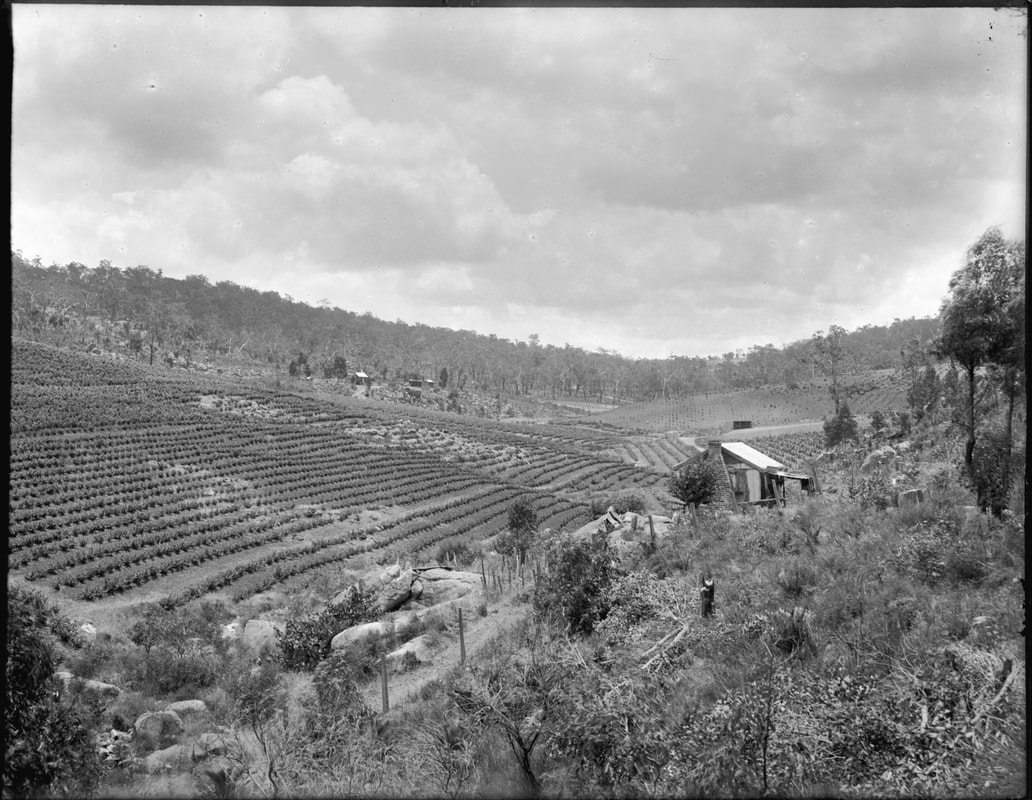
Glen Hardey Vineyard, Smith's Mill, the property of Mr R. W. Hardey, 1907. Right side of panorama.
The State Library of Western Australia as the source of the work.
|
In 1897, the vineyard on the Peninsula was still producing a vintage, as it had done for years, with the harvesting of the valley grapes being done at Smith's Mill, moved by rail to Maylands in bulk. The grapes then transported, via the heavy sand track, and processed, fermented and cellared on the Peninsula. The building was three stories high, and the wine was moved from the ground floor, to the first, and second in order of maturity. Altogether he had 10,000 gallons in stock, irrespective of that year's vintage. Some of the cellared wine was 20 years old. By 1897, high rail transport costs forced Richard to build a brick fermenting house and cellars at 'Glen Hardey'. The last wine was made at 'Glen Hardey' in around 1946. Bushfires destroyed the vines in 1950.
The large 'Mt. Hardey Estate', near York, was subdivided during 1898, into 100 blocks of 500 acres. This was called the 'Hardey Agricultural Area', which had been acquired and subdivided under the Agricultural Lands Purchase Act, to establish homes and farms.
Richard Watson Hardey died at 'Tranby Park', on the Peninsula, on 12th of February 1910, aged 66 years.
He was buried at East Perth Cemetery in the Wesleyan section.
Richard Watson Hardey died at 'Tranby Park', on the Peninsula, on 12th of February 1910, aged 66 years.
He was buried at East Perth Cemetery in the Wesleyan section.
More on the PeninsulaNote: In 1924, a good part western side of the Peninsula became Mayland's Aerodrome. It was the first permanent aerodrome in Perth and functioned as its principal aerodrome throughout the 1920s, 1930s and the first half of the 1940s. The airport formally opened in 1924, when West Australian Airways (“WAA”) immediately moved their hangar from Perth’s Esplanade.
Of historical importance, Maylands Airport was where Charles Kingsford-Smith made his landing to complete the first non-stop flight across Australia. It contributed significantly to the war effort during WWII and continued to be an important facility for general aviation activities until its closure in 1963. During World War II, Maylands Airfield was requisitioned by the Royal Australian Air Force. This built-up area and hangers later became the Western Australian Police Forces, Maylands Police Complex and Academy. 
A major section of the old aerodrome area is now the Peninsula Golf Course. The public golf course opened in 1994 as a 9-hole course, becoming an 18-hole course some time later. The previous function of Maylands Peninsula will forever be remembered, as the holes on the course commemorate the pioneering pilots in the exciting birth of the air travel industry, |
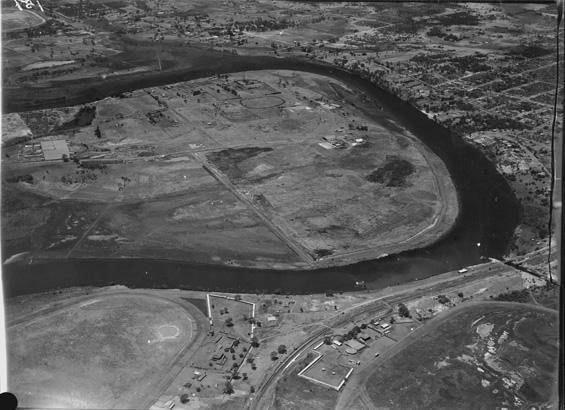
The Peninsula in 1935. Maylands Airport in the right foreground.
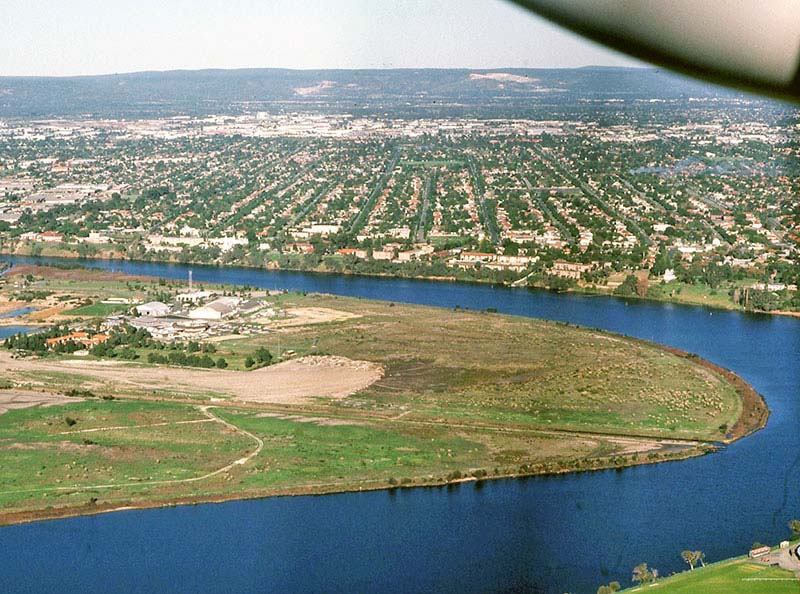
Maylands Police Complex following the closure of the airfield.
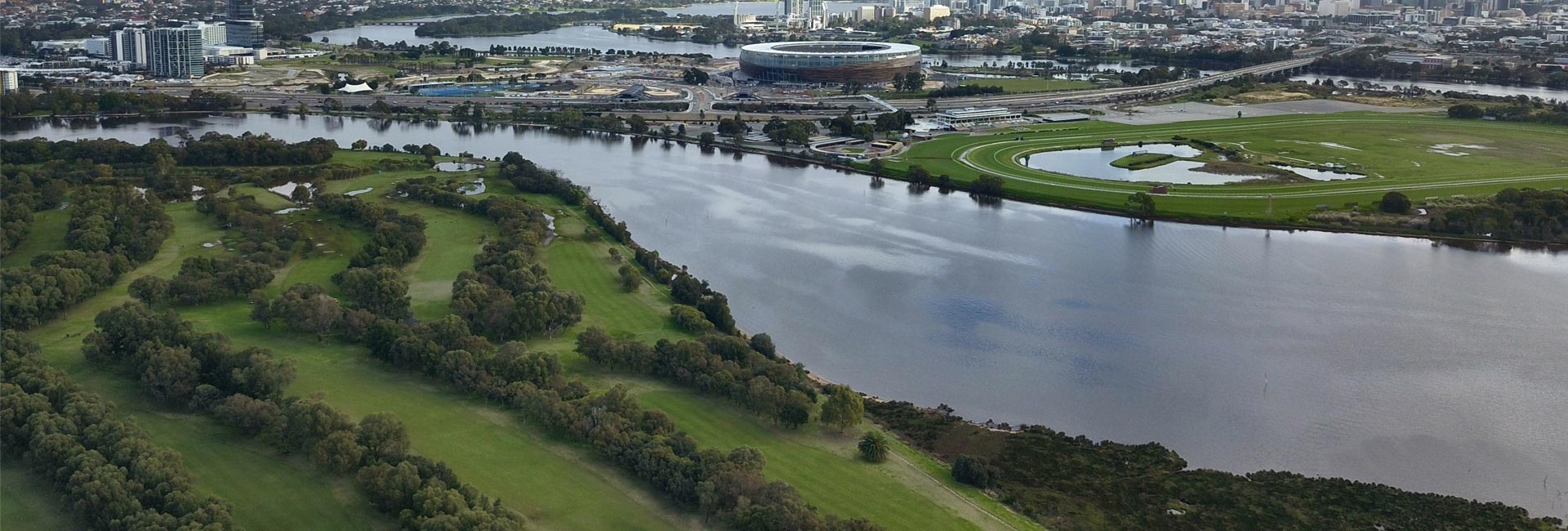
The Peninsula Golf Club on the left
|
For Tranby pre-departure information about Joseph Hardey and Ann Robinson, in England [Click Here]